Assessment of CO₂ Emissions from Solid Waste at Kebon Kongok Landfill Using Warm Analysis
DOI:
https://doi.org/10.22452/Keywords:
Solid waste management, greenhouse gas emissions, recycling activities, energy consumption, waste reduction modelAbstract
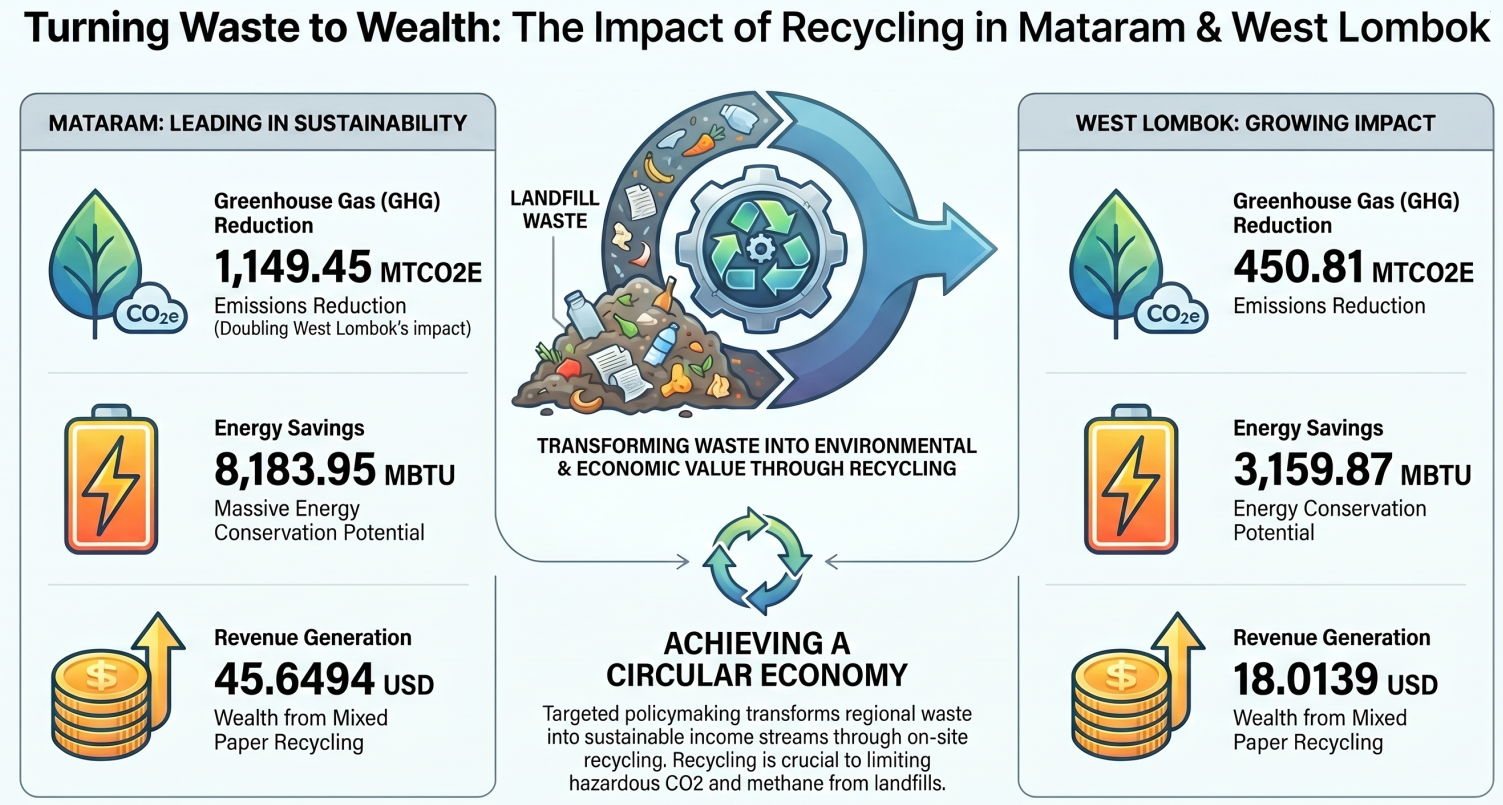
The impact of climate change is interrelated with greenhouse gas emissions. The pollutants from greenhouse gases come from carbon dioxide (CO2) and methane gases. Therefore, estimating the CO2 emission contributing to the greenhouse phenomenon’s hazardous environment is crucial. The Waste Reduction Model (WARM), created by the Environmental Protection Agency (EPA), provides high-level comparisons of potential greenhouse gas emissions reductions, energy savings, and economic impacts when considering different materials management practices. Materials management practices in WARM include source reduction, recycling, anaerobic digestion, combustion, composting, and landfilling. It can be noted that most landfill sites do not have materials recovery facilities for recycling purposes. Thus, it is crucial to estimate the potential impact of recycling efforts, as this could lead to a significant reduction in the amount of garbage going to landfills and limit CO2 emissions. This study examines the environmental and economic impacts of solid waste management practices at the Kebon Kongok Landfill in West Lombok, Indonesia, and the potential of adopting recycling activities. WARM can estimate greenhouse gas (GHG) emissions, energy consumption, and potential revenue from recycling activities in these two regions (Mataram and West Lombok). Raw data from the daily waste collection in the landfill from both sites were collected, and the amount was inserted into WARM. The results demonstrate the efficacy of recycling scenarios in reducing GHG emissions and conserving energy. It can be noted that Mataram's recycling efforts can result in a value of 1,149.45 MTCO2E reduction, which is more than double the 450.81 MTCO2E in West Lombok. Hence, the energy saving of 8183.95 MBTU for Mataram can be significantly achieved compared to West Lombok (3159.87 MBTU). The research highlights the economic benefits of recycling for both regions if the recycling effort is adopted on-site. In Mataram, recycling activities can yield a substantial revenue of USD 45.6494 from mixed paper alone. Meanwhile, mixed paper recycling in West Lombok can generate a significant income of USD 18.0139. These findings underscore the effectiveness of recycling initiatives in reducing GHG emissions, conserving energy, and generating economic value while emphasising the importance of tailored waste management strategies to address regional variations in waste composition and consumption patterns. Therefore, strong policymaking can be introduced to adapt recycling activities for income generation, thereby transforming waste into wealth in achieving a circular economy.
References
Abir T M., Datta M and Saha S R. (2023) Assessing the Factors Influencing Effective Municipal Solid Waste Management System in Barishal Metropolitan Areas Journal of Geoscience Environmental Protection 11(1):49–66 doi: 10.4236/gep.2023.111004.
Abu Hassan M., Kasmuri N and Basri M. (2019) Assessment of CO2 Emission and Energy Reduction on Solid Waste in Jeram Landfill Using Warm Analysis International Journal of Integrated Engineering 11:019 doi: 10.30880/ijie.2019.11.01.019.
Anshassi M and Townsend T G. (2021) Reviewing the underlying assumptions in waste LCA models to identify impacts on waste management decision making Journal of Cleaner Production 313:127913 doi: 10.1016/j.jclepro.2021.127913.
Brotosusilo A and Handayani D. (2020) Dataset on waste management behaviours of urban citizens in large cities of Indonesia Data in Brief 32 doi: 10.1016/j.dib.2020.106053.
Chai X., Tonjes D J and Mahajan D. (2016) Methane emissions as energy reservoir: Context, scope, causes and mitigation strategies Progress in Energy and Combustion Science 56:33-70 doi: 10.1016/j.pecs.2016.05.001.
Chen D M C., Bodirsky B L., Krueger T., Mishra A and Popp A. (2020) The world’s growing municipal solid waste: trends and impacts Environmental Research Letters 15(7) doi: 10.1088/1748-9326/ab8659.
Dąbrowska J., Sobota M., Świderska M., Borowski P., Moryl A., Stodolak R., Kucharczak E., Zięba Z and Kazak J. (2021) Marine waste—Sources, fate, risks, challenges and research needs International Journal of Environmental Research & Public Health 18(2):433 doi: 10.3390/ijerph18020433.
de Meij A. (2020) Annual European Union greenhouse gas inventory 1990–2018 and inventory report 2020 European Commission in DG Climate Action European Environment Agency.
Engelmann P., Santos V., Rocha P., Santos G., Lourega R., Lima J and Pires M. (2022) Analysis of solid waste management scenarios using the WARM model: Case study Journal of Cleaner Production 345:130687-130687 doi 10.1016/j.jclepro.2022.130687.
Genc A., Zeydan Ö., and Sarac S. (2019) Cost analysis of plastic solid waste recycling in an urban district in Turkey Waste Management & Research 37:906-913 doi: 10.1177/0734242X19858665.
Gunawan J., Permatasari P and Tilt C. (2020) Sustainable development goal disclosures: Do they support responsible consumption and production? Journal of Cleaner Production 246 doi: 10.1016/j.jclepro.2019.118989.
Han J., Ijuin H., Kinohista Y., Yamada T., Yamada S and Inoue M. (2021) Sustainability Assessment of Reuse and Recycling Management Options for End-of-Life Computers-Korean and Japanese Case Study Analysis Recycling 6:55 doi: 10.3390/recycling6030055.
Hardesty B et al., (2016) Estimating quantities and sources of marine debris at a continental scale Frontiers in Ecology and the Environment 15 doi: 10.1002/fee.1447.
Ismail H., Hassan C., Jamal M., Martin J., Mat Salleh M Z., Chik W., N. Rahim, and Yusof N A U. (2018) Potential revenue from solid waste recycling practices in Faculty of Civil Engineering UiTM Johor, Pasir Gudang Campus Journal of Applied and Fundamental Sciences 10:2540-2550 doi: 10.4314/jfas.v10i6s.193.
Kalkanis K., Alexakis D E., Kyriakis E. et al. (2022) Transforming Waste to Wealth, Achieving Circular Economy Circular Economy and Sustainability 2:1541–1559 https://doi.org/10.1007/s43615-022-00225-2.
Landrigan P., Stegeman J., Fleming L., Allemand D., Anderson D., Backer L., Brucker-Davis F., Chevalier N., Corra L., Czerucka D., Dechraoui Bottein M Y., Demeneix B., Depledge M., Deheyn D., Dorman C., Fénichel P., Fisher S., Gaill F., Galgani F and Rampal P. (2020) Human health and ocean pollution Annals of Global Health 86(1):1-64 doi: 10.5334/aogh.2831.
Larouche F., Tedjar F., Amouzegar K., Houlachi G., Bouchard P., Demopoulos G and Zaghib K. (2020) Progress and Status of Hydrometallurgical and Direct Recycling of Li-Ion Batteries and Beyond Materials 13:801 doi: 10.3390/ma13030801.
Liu M., Tan S., Zhang M., He G., Chen Z., Fu Z and Luan C. (2020) Wastepaper recycling decision system based on material flow analysis and life cycle assessment: A case study of waste paper recycling from China Journal of Environmental Management 255:109859 doi 10.1016/j.jenvman.2019.109859.
Mallick K., Sahu A., Dubey N and Das A. (2023) Harvesting marine plastic pollutants-derived renewable energy: A comprehensive review on applied energy and sustainable approach Journal of Environmental Management 348:119371 doi 10.1016/j.jenvman.2023.119371.
Ministry of Environment and Forestry (MEF) Indonesia (2021) Directorate General of Climate Change Third Biennial Update Report Under the United Nations Framework Convention on Climate Change.
Nepal M., Bharadwaj B and Rai R. (2020) Sustainable financing for municipal solid waste management in Nepal PLoS ONE doi: 10.1371/journal.pone.0231933.
Nizar M., Munir E., Matseh I and Fakhrurrazi F. (2019) Examining the Economic Benefits of Urban Waste Recycle Based on Zero Waste Concepts doi: 10.2991/agc-18.2019.47.
Rakhman M., Busyairi M and Kahar A. (2022) Analisis Timbulan dan Komposisi Sampah Perumahan dan Non Perumahan Wilayah Kabupaten Kutai Kartanegara (Studi Kasus: Kecamatan Anggana) Jurnal Teknologi Lingkungan UNMUL 6(2):24-32 doi: 10.30872/jtlunmul.v6i2.8109.
Rangga J., Sharifah S I., Rasdi I and Karuppiah K. (2022) Waste Management Costs Reduction and the Recycling Profit Estimation from the Segregation Programme in Malaysia Pertanika Journal of Science and Technology 30:1457-1478 doi: 10.47836/pjst.30.2.34.
Samadikun B., Sinttia D., Rezagama A., Sumiyati S., Huboyo H., Ramadan B., Hadiwidodo M and Nabila F. (2021) The economic potential of paper waste recycling activities on the informal sector in Grobogan District a case study: Purwodadi Sub-district IOP Conference Series: Earth and Environmental Science 623:012077 doi: 10.1088/1755-1315/623/1/012077.
Scheutz C., Duan Z., Møller J., Kjeldsen P. (2023) Environmental assessment of landfill gas mitigation using biocover and gas collection with energy utilisation at aging landfills Waste Management 165:40-50.
Tesseme A T., Vinti G and Vaccari M. (2022) Pollution potential of dumping sites on surface water quality in Ethiopia using leachate and comprehensive pollution indices Environmental Monitoring Assessment 194(8):545 doi: 10.1007/s10661-022-10217-2.
U.S. Environmental Protection Agency (EPA). (2018) National Overview: Facts and Figures on Materials Wastes and Recycling United States.
U.S. Environmental Protection Agency (EPA). (2020) Documentation for greenhouse gas emission and energy factors used in the waste reduction model (WARM) United States.
U.S. Environmental Protection Agency (EPA). (2023) Documentation for greenhouse gas emission and energy factors used in the waste reduction model (WARM): Management practices chapters United States.
Velis C A and Cook E. (2021) Mismanagement of Plastic Waste through Open Burning with Emphasis on the Global South: A Systematic Review of Risks to Occupational and Public Health Environmental Science Technology 55(11):7186–7207 doi: 10.1021/acs.est.0c08536.
Vinti G et al., (2021) Municipal solid waste management and adverse health outcomes: A systematic review International Journal Environmental Research Public Health 18(8):1–26 doi: 10.3390/ijerph18084331.
Vogt B., Stokes K and Kumar S. (2021) Why is Recycling of Postconsumer Plastics so Challenging? ACS Applied Polymer Materials 3 doi: 10.1021/acsapm.1c00648.
Downloads
Published
Issue
Section
License
Copyright (c) 2026 Malaysian Journal of Science (MJS)

This work is licensed under a Creative Commons Attribution-NonCommercial 4.0 International License.
Transfer of Copyrights
- In the event of publication of the manuscript entitled [INSERT MANUSCRIPT TITLE AND REF NO.] in the Malaysian Journal of Science, I hereby transfer copyrights of the manuscript title, abstract and contents to the Malaysian Journal of Science and the Faculty of Science, University of Malaya (as the publisher) for the full legal term of copyright and any renewals thereof throughout the world in any format, and any media for communication.
Conditions of Publication
- I hereby state that this manuscript to be published is an original work, unpublished in any form prior and I have obtained the necessary permission for the reproduction (or am the owner) of any images, illustrations, tables, charts, figures, maps, photographs and other visual materials of whom the copyrights is owned by a third party.
- This manuscript contains no statements that are contradictory to the relevant local and international laws or that infringes on the rights of others.
- I agree to indemnify the Malaysian Journal of Science and the Faculty of Science, University of Malaya (as the publisher) in the event of any claims that arise in regards to the above conditions and assume full liability on the published manuscript.
Reviewer’s Responsibilities
- Reviewers must treat the manuscripts received for reviewing process as confidential. It must not be shown or discussed with others without the authorization from the editor of MJS.
- Reviewers assigned must not have conflicts of interest with respect to the original work, the authors of the article or the research funding.
- Reviewers should judge or evaluate the manuscripts objective as possible. The feedback from the reviewers should be express clearly with supporting arguments.
- If the assigned reviewer considers themselves not able to complete the review of the manuscript, they must communicate with the editor, so that the manuscript could be sent to another suitable reviewer.
Copyright: Rights of the Author(s)
- Effective 2007, it will become the policy of the Malaysian Journal of Science (published by the Faculty of Science, University of Malaya) to obtain copyrights of all manuscripts published. This is to facilitate:
- Protection against copyright infringement of the manuscript through copyright breaches or piracy.
- Timely handling of reproduction requests from authorized third parties that are addressed directly to the Faculty of Science, University of Malaya.
- As the author, you may publish the fore-mentioned manuscript, whole or any part thereof, provided acknowledgement regarding copyright notice and reference to first publication in the Malaysian Journal of Science and Faculty of Science, University of Malaya (as the publishers) are given. You may produce copies of your manuscript, whole or any part thereof, for teaching purposes or to be provided, on individual basis, to fellow researchers.
- You may include the fore-mentioned manuscript, whole or any part thereof, electronically on a secure network at your affiliated institution, provided acknowledgement regarding copyright notice and reference to first publication in the Malaysian Journal of Science and Faculty of Science, University of Malaya (as the publishers) are given.
- You may include the fore-mentioned manuscript, whole or any part thereof, on the World Wide Web, provided acknowledgement regarding copyright notice and reference to first publication in the Malaysian Journal of Science and Faculty of Science, University of Malaya (as the publishers) are given.
- In the event that your manuscript, whole or any part thereof, has been requested to be reproduced, for any purpose or in any form approved by the Malaysian Journal of Science and Faculty of Science, University of Malaya (as the publishers), you will be informed. It is requested that any changes to your contact details (especially e-mail addresses) are made known.
Copyright: Role and responsibility of the Author(s)
- In the event of the manuscript to be published in the Malaysian Journal of Science contains materials copyrighted to others prior, it is the responsibility of current author(s) to obtain written permission from the copyright owner or owners.
- This written permission should be submitted with the proof-copy of the manuscript to be published in the Malaysian Journal of Science
Licensing Policy
Malaysian Journal of Science is an open-access journal that follows the Creative Commons Attribution-Non-commercial 4.0 International License (CC BY-NC 4.0)
CC BY – NC 4.0: Under this licence, the reusers to distribute, remix, alter, and build upon the content in any media or format for non-commercial purposes only, as long as proper acknowledgement is given to the authors of the original work. Please take the time to read the whole licence agreement (https://creativecommons.org/licenses/by-nc/4.0/legalcode ).