Surface Temperature and Pressure Drop Simulation Analysis of Nanofluid Flow in Microchannel Heat Sink
DOI:
https://doi.org/10.22452/Keywords:
Nanofluid, Heat transfer, Temperature, Pressure drop, Microchannel heat sinkAbstract
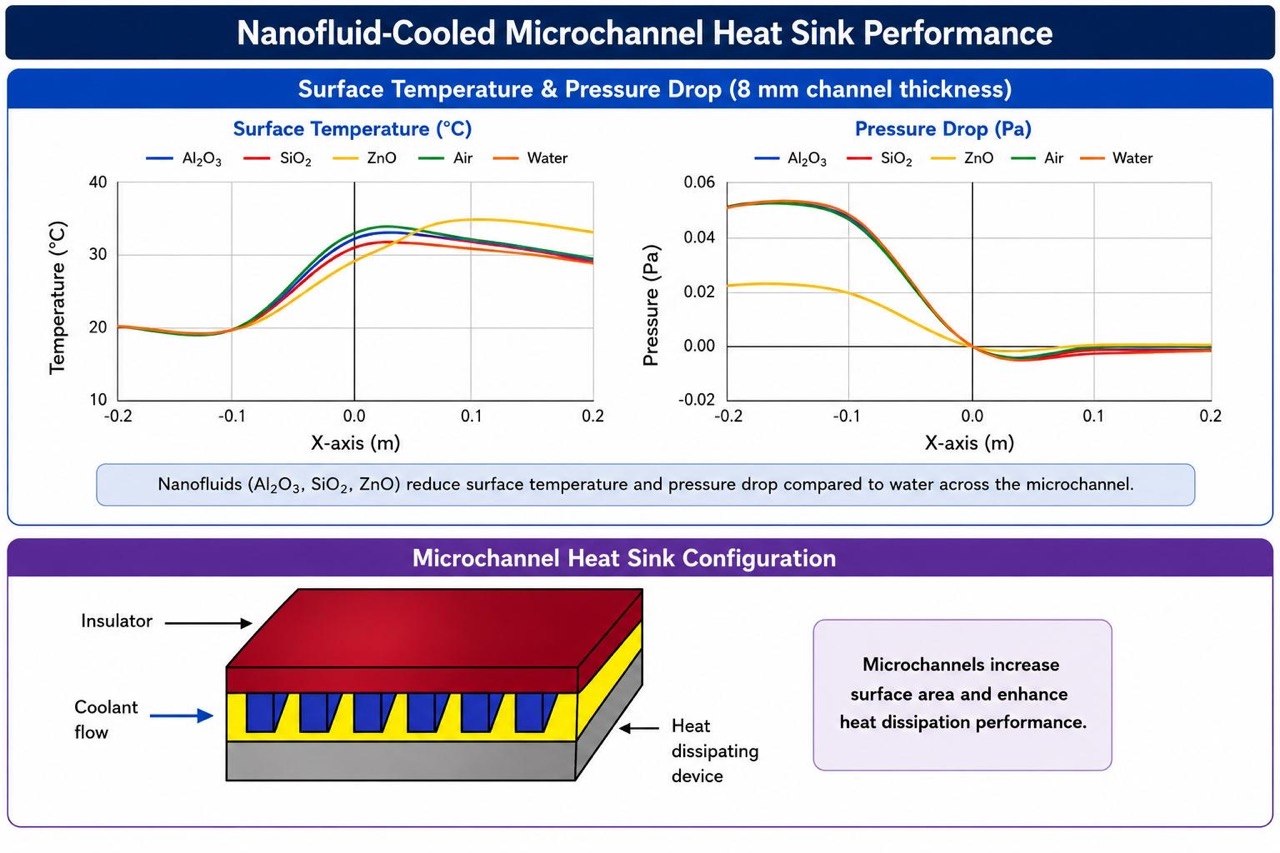
The increasing demand for high-performance electronic devices has driven the need more effective thermal management solutions. Standard air-cooling methods fall short when handling high heat flow rates. Among the most promising solutions is the Micro Channel Heat Sink (MCHS), specifically designed to address this challenge. To draw heat away from the chip, a cold liquid navigates intricate channels within the electronic system. The design of the heat sink profoundly influences crucial factors, such as microchannel area, heatsink size, channel width, height, and inlet/outlet diameters, each of which is affected differently by the heat sink's configuration. This study investigated heat transfer performance across various thicknesses, exploring nanoliquids, air, and water as cooling agents. After reviewing the setup steps, the ideal fluid performance for the given design is identified. Using COMSOL Multiphysics 5.5 software, a 3D model of a rectangular copper MCHS is created employing the finite element method. Results indicate that a 5 mm channel thickness using Aluminum oxide (Al2O3) nanofluids yields the most promising thickness based on the findings. Al2O3 exhibits outstanding performance, maintaining momentum even at lower temperatures. The influence of fluid flow velocity on the MCHS is reflected in the 5 mm channel thickness, significantly impacting the effective pressure drop. One avenue for potentially enhancing performance involves considering the aspect ratio of nanofluidic particles and exploring diverse materials such as iron and aluminum.
References
Ahmed, H. E., Salman, B. H., Kherbeet, A. S., & Ahmed, M. I. (2018). Optimization of thermal design of heat sinks: A review. International Journal of Heat and Mass Transfer, 118, 129-153.
Alkasmoul, F. S., Asaker, M., Almogbel, A., & AlSuwailem, A. (2022). Combined effect of thermal and hydraulic performance of different nanofluids on their cooling efficiency in microchannel heat sink. Case Studies in Thermal Engineering, 30, 101776.
Al-Rashed, A. A., Shahsavar, A., Entezari, S., Moghimi, M. A., Adio, S. A., & Nguyen, T. K. (2019). Numerical investigation of non-Newtonian water-CMC/CuO nanofluid flow in an offset strip-fin microchannel heat sink: thermal performance and thermodynamic considerations. Applied Thermal Engineering, 155, 247-258.
Alsabery, A. I., Gedik, E., Chamkha, A. J., & Hashim, I. (2019). Effects of two-phase nanofluid model and localized heat source/sink on natural convection in a square cavity with a solid circular cylinder. Computer Methods in Applied Mechanics and Engineering, 346, 952-981.
Behnampour, A., Akbari, O. A., Safaei, M. R., Ghavami, M., Marzban, A., Shabani, G. A. S., & Mashayekhi, R. (2017). Analysis of heat transfer and nanofluid fluid flow in microchannels with trapezoidal, rectangular and triangular shaped ribs. Physica E: Low-Dimensional Systems and Nanostructures, 91, 15-31.
Cao, Y., Abbas, M., El-Shorbagy, M. A., Gepreel, K. A., Dahari, M., Badran, M. F., ... & Wae-hayee, M. (2022). Thermo-hydraulic performance in ceramic-made microchannel heat sinks with an optimum fin geometry. Case Studies in Thermal Engineering, 36, 102230.
Chen, X., & Chen, Y. (2021). A review on modelling, simulation and experiment of thermal conductivity of nanofluids. International Journal of Environmental Analytical Chemistry, 101(10), 1347-1362.
Choi, S. U., & Eastman, J. A. (1995). Enhancing thermal conductivity of fluids with nanoparticles (No. ANL/MSD/CP-84938; CONF-951135-29). Argonne National Lab. (ANL), Argonne, IL (United States).
Coşkun, T., & Çetkin, E. (2020). Heat transfer enhancement in a microchannel heat sink: nanofluids and/or micro pin fins. Heat Transfer Engineering, 41(21), 1818-1828.
Dhaiban, H. T., & Hussein, M. A. (2020). The optimal design of heat sinks: A review. Journal of applied and computational mechanics, 6(4), 1030-1043.
Dogonchi, A. S., & Ganji, D. D. (2016). Investigation of MHD nanofluid flow and heat transfer in a stretching/shrinking convergent/divergent channel considering thermal radiation. Journal of Molecular Liquids, 220, 592-603.
Elbadawy, I., Alhajri, A., Doust, M., Almulla, Y., Fayed, M., Dinc, A., ... & Al-Kouz, W. (2023). Reliability of different nanofluids and different micro-channel configurations on the heat transfer augmentation. Processes, 11(3), 652.
Gao, J., Hu, Z., Yang, Q., Liang, X., & Wu, H. (2022). Fluid flow and heat transfer in microchannel heat sinks: Modelling review and recent progress. Thermal Science and Engineering Progress, 29, 101203.
Gunnasegaran, P., Shuaib, N. H., Mohammed, H. A., Jalal, M. A., & Sandhita, E. (2012). Heat transfer enhancement in microchannel heat sink using nanofluids. Fluid Dynamics, Computational Modeling and Applications, 287-326.
Hamilton, R. L., & Crosser, O. K. (1962). Thermal conductivity of heterogeneous two-component systems. Industrial & Engineering chemistry fundamentals, 1(3), 187-191.
Iyengar, M., & Bar-Cohen, A. (1998). Optimization of vertical pin-fin heat sinks in natural convective heat transfer. In International Heat Transfer Conference Digital Library. Begel House Inc.
Jennings Jr, D., & Smith, S. (2020, October). Comparative Study of Effective Cooling in Microchannel Heat Sinks (MCHS) With Nanofluid and Hydrophobic Nanostructures Using Computational Fluid Dynamics. In International Electronic Packaging Technical Conference and Exhibition (Vol. 84041, p. V001T07A002). American Society of Mechanical Engineers.
Li, W., Xie, Z., Xi, K., Xia, S., & Ge, Y. (2021). Constructal optimization of rectangular microchannel heat sink with porous medium for entropy generation minimization. Entropy, 23(11), 1528.
Li, W., Zhu, L., Ji, F., Yu, J., Jin, Y., & Wang, W. (2020, July). Optimization of Manifold Mmicrochannel Heat Sink Based on Equivalent Resistance Model. In 2020 19th IEEE Intersociety Conference on Thermal and Thermomechanical Phenomena in Electronic Systems (ITherm) (pp. 497-500). IEEE.
Li, X., & Chen, J. (2019). Microembossed copper microchannel heat sink for high‐density cooling in electronics. Micro & Nano Letters, 14(12), 1258-1262.
Liou, T. M., Chang, S. W., & Chan, S. P. (2018). Effect of rib orientation on thermal and fluid-flow features in a two-pass parallelogram channel with abrupt entrance. International Journal of Heat and Mass Transfer, 116, 152-165.
Littmarck, H. S., & Saeidi, F. (1986). Comsol. COMSOL. Available: https://www. comsol. com/.,(accessed Aug. 1, 2022).
Malvandi, A., & Ganji, D. D. (2014). Brownian motion and thermophoresis effects on slip flow of alumina/water nanofluid inside a circular microchannel in the presence of a magnetic field. International Journal of Thermal Sciences, 84, 196-206.
Memon, S. A., Cheema, T. A., Kim, G. M., & Park, C. W. (2020). Hydrothermal investigation of a microchannel heat sink using secondary flows in trapezoidal and parallel orientations. Energies, 13(21), 5616.
Mohammed, H. A., Gunnasegaran, P., & Shuaib, N. H. (2010). Heat transfer in rectangular microchannels heat sink using nanofluids. International Communications in Heat and Mass Transfer, 37(10), 1496-1503.
Muneeshwaran, M., Srinivasan, G., Muthukumar, P., & Wang, C. C. (2021). Role of hybrid-nanofluid in heat transfer enhancement–A review. International Communications in Heat and Mass Transfer, 125, 105341.
Nazzal, I. T., Salem, T. K., & Al Doury, R. R. J. (2021, February). Theoretical investigation of a pin fin heat sink performance for electronic cooling using different alloys materials. In IOP Conference Series: Materials Science and Engineering (Vol. 1094, No. 1, p. 012087). IOP Publishing.
Pak, B. C., & Cho, Y. I. (1998). Hydrodynamic and heat transfer study of dispersed fluids with submicron metallic oxide particles. Experimental Heat Transfer an International Journal, 11(2), 151-170.
Patel, A. K., Bhuvad, S., & Rajput, S. P. S. (2019). Effects of nanofluid flow in micro channel heat sink for forced convection cooling of electronics device: a numerical simulation. Int J Innov Technol Exploring Eng (IJITEE), 9(2), 5230-5243.
Rafiq, M., Shafique, M., Azam, A., & Ateeq, M. (2021). Transformer oil-based nanofluid: The application of nanomaterials on thermal, electrical and physicochemical properties of liquid insulation-A review. Ain Shams Engineering Journal, 12(1), 555-576.
Rajput, R. S. & Sahu, H. (2021). Investigation of different types of heat sink and their applications. International Journal of Rubber Technology (IJRT), 6(3), 105-109.
Shamsuddin, H. S., Estelle, P., Navas, J., Mohd-Ghazali, N., & Mohamad, M. (2021). Effects of surfactant and nanofluid on the performance and optimization of a microchannel heat sink. International Journal of Heat and Mass Transfer, 175, 121336.
Sohel, M. R., Khaleduzzaman, S. S., Saidur, R., Hepbasli, A., Sabri, M. F. M., & Mahbubul, I. M. (2014). An experimental investigation of heat transfer enhancement of a minichannel heat sink using Al2O3–H2O nanofluid. International Journal of Heat and Mass Transfer, 74, 164-172.
Song, J., Liu, F., Sui, Y., & Jing, D. (2021). Numerical studies on the hydraulic and thermal performances of trapezoidal microchannel heat sink. International Journal of Thermal Sciences, 161, 106755.
Sur, A., & Gulia, V. (2022). A comprehensive review on microchannel heat exchangers, heat sink, and polymer heat exchangers: Current state of the art. Frontiers in Heat and Mass Transfer (FHMT), 18.
Tang, K., Lin, G., Guo, Y., Huang, J., Zhang, H., & Miao, J. (2023). Simulation and optimization of thermal performance in diverging/converging manifold microchannel heat sink. International Journal of Heat and Mass Transfer, 200, 123495.
Tuckerman, D. B., & Pease, R. F. W. (1981). High-performance heat sinking for VLSI. IEEE Electron device letters, 2(5), 126-129.
Van Oevelen, T. (2014). Optimal heat sink design for liquid cooling of electronics.
Waqas, H., Khan, S. A., Farooq, U., Muhammad, T., Alshehri, A., & Yasmin, S. (2022). Thermal transport analysis of six circular microchannel heat sink using nanofluid. Scientific Reports, 12(1), 8035.
Zhang, J., Guo, W., Xie, Z., Guan, X., Qu, X., & Ge, Y. (2023). Optimization of fin layout in liquid-cooled microchannels for multi-core chips. Case Studies in Thermal Engineering, 41, 102615.
Downloads
Published
Issue
Section
License
Copyright (c) 2026 Malaysian Journal of Science (MJS)

This work is licensed under a Creative Commons Attribution-NonCommercial 4.0 International License.
Transfer of Copyrights
- In the event of publication of the manuscript entitled [INSERT MANUSCRIPT TITLE AND REF NO.] in the Malaysian Journal of Science, I hereby transfer copyrights of the manuscript title, abstract and contents to the Malaysian Journal of Science and the Faculty of Science, University of Malaya (as the publisher) for the full legal term of copyright and any renewals thereof throughout the world in any format, and any media for communication.
Conditions of Publication
- I hereby state that this manuscript to be published is an original work, unpublished in any form prior and I have obtained the necessary permission for the reproduction (or am the owner) of any images, illustrations, tables, charts, figures, maps, photographs and other visual materials of whom the copyrights is owned by a third party.
- This manuscript contains no statements that are contradictory to the relevant local and international laws or that infringes on the rights of others.
- I agree to indemnify the Malaysian Journal of Science and the Faculty of Science, University of Malaya (as the publisher) in the event of any claims that arise in regards to the above conditions and assume full liability on the published manuscript.
Reviewer’s Responsibilities
- Reviewers must treat the manuscripts received for reviewing process as confidential. It must not be shown or discussed with others without the authorization from the editor of MJS.
- Reviewers assigned must not have conflicts of interest with respect to the original work, the authors of the article or the research funding.
- Reviewers should judge or evaluate the manuscripts objective as possible. The feedback from the reviewers should be express clearly with supporting arguments.
- If the assigned reviewer considers themselves not able to complete the review of the manuscript, they must communicate with the editor, so that the manuscript could be sent to another suitable reviewer.
Copyright: Rights of the Author(s)
- Effective 2007, it will become the policy of the Malaysian Journal of Science (published by the Faculty of Science, University of Malaya) to obtain copyrights of all manuscripts published. This is to facilitate:
- Protection against copyright infringement of the manuscript through copyright breaches or piracy.
- Timely handling of reproduction requests from authorized third parties that are addressed directly to the Faculty of Science, University of Malaya.
- As the author, you may publish the fore-mentioned manuscript, whole or any part thereof, provided acknowledgement regarding copyright notice and reference to first publication in the Malaysian Journal of Science and Faculty of Science, University of Malaya (as the publishers) are given. You may produce copies of your manuscript, whole or any part thereof, for teaching purposes or to be provided, on individual basis, to fellow researchers.
- You may include the fore-mentioned manuscript, whole or any part thereof, electronically on a secure network at your affiliated institution, provided acknowledgement regarding copyright notice and reference to first publication in the Malaysian Journal of Science and Faculty of Science, University of Malaya (as the publishers) are given.
- You may include the fore-mentioned manuscript, whole or any part thereof, on the World Wide Web, provided acknowledgement regarding copyright notice and reference to first publication in the Malaysian Journal of Science and Faculty of Science, University of Malaya (as the publishers) are given.
- In the event that your manuscript, whole or any part thereof, has been requested to be reproduced, for any purpose or in any form approved by the Malaysian Journal of Science and Faculty of Science, University of Malaya (as the publishers), you will be informed. It is requested that any changes to your contact details (especially e-mail addresses) are made known.
Copyright: Role and responsibility of the Author(s)
- In the event of the manuscript to be published in the Malaysian Journal of Science contains materials copyrighted to others prior, it is the responsibility of current author(s) to obtain written permission from the copyright owner or owners.
- This written permission should be submitted with the proof-copy of the manuscript to be published in the Malaysian Journal of Science
Licensing Policy
Malaysian Journal of Science is an open-access journal that follows the Creative Commons Attribution-Non-commercial 4.0 International License (CC BY-NC 4.0)
CC BY – NC 4.0: Under this licence, the reusers to distribute, remix, alter, and build upon the content in any media or format for non-commercial purposes only, as long as proper acknowledgement is given to the authors of the original work. Please take the time to read the whole licence agreement (https://creativecommons.org/licenses/by-nc/4.0/legalcode ).