Phytoremediation of Domestic Wastewater Using Aquatic Plants and Their Characterization: A Sustainable Approach for Wastewater Treatment
DOI:
https://doi.org/10.22452/Keywords:
Azolla microphylla; Domestic wastewater; Lemna minor; PhytoremediationAbstract
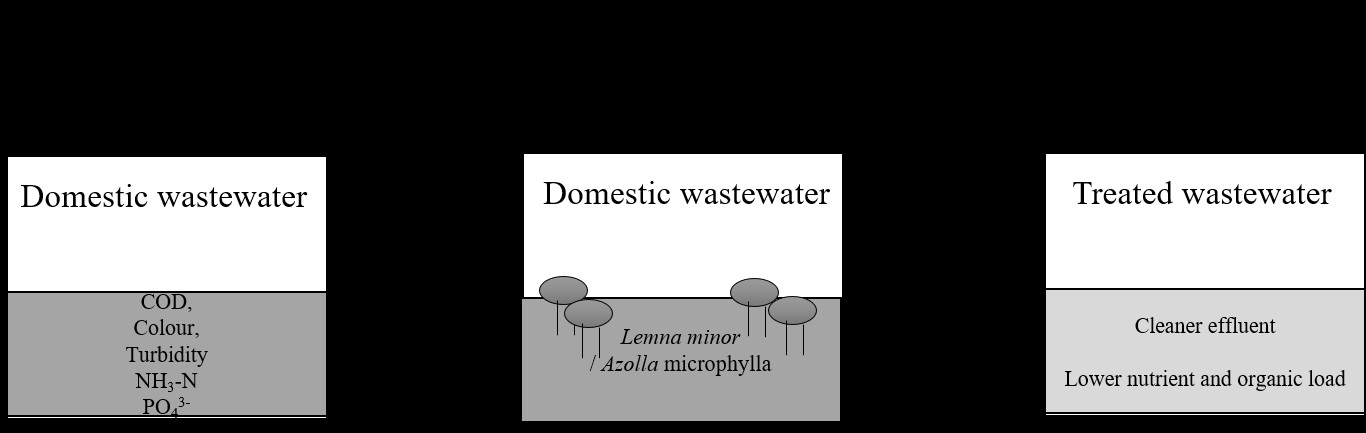
Water pollution caused by domestic wastewater discharge poses significant environmental challenges, necessitating sustainable and efficient treatment solutions. This study explores the potential of aquatic plants, specifically Azolla microphylla and Lemna minor for the phytoremediation of domestic wastewater. The removal efficiency of these plants was evaluated based on various factors including plant type, duration, weight and solution pH with a focus on the removal of both organic and inorganic compounds, such as ammoniacal nitrogen, total phosphate, color, and turbidity. The findings demonstrated the effectiveness of both species in removing these pollutants, with Lemna minor exhibiting superior performance. The highest removal efficiencies for ammoniacal nitrogen, color, and turbidity were 82.0%, 74.3%, and 77.4%, respectively, achieved with 7g of Lemna minor in 300 ml of domestic wastewater at natural solution pH. Pre- and post-phytoremediation characterization was conducted using X-ray diffraction (XRD), thermogravimetric analysis (TGA), and scanning electron microscopy (SEM) incorporated with energy-dispersive X-ray spectroscopy (EDX) to analyze the structural and compositional changes in the plant biomass. This study highlights the potential of Azolla microphylla and Lemna minor as natural phytoremediators for wastewater treatment, contributing to sustainable waste management.
References
Akhtar, M., Sarwar, N., Ashraf, A., Ejaz, A., Ali, S., & Rizwan, M. (2021). Beneficial role of Azolla sp. in paddy soils and their use as bioremediators in polluted aqueous environments: implications and future perspectives. Archives of Agronomy and Soil Science, 67(9), 1242–1255. https://doi.org/10.1080/03650340.2020.1786885
Al-dhawi, B. N. S., Kutty, S. R. M., Ghaleb, A. A. S., Almahbashi, N. M. Y., Saeed, A. A. H., Al-Mekhlafi, A. B. A., Alsaeedi, Y. A. A., & Jagaba, A. H. (2023). Pretreated palm oil clinker as an attached growth media for organic matter removal from synthetic domestic wastewater in a sequencing batch reactor. Case Studies in Chemical and Environmental Engineering, 7, 100294. https://doi.org/10.1016/j.cscee.2022.100294
Ansari, A. A., Naeem, M., Gill, S. S., & AlZuaibr, F. M. (2020). Phytoremediation of contaminated waters: An eco-friendly technology based on aquatic macrophytes application. Egyptian Journal of Aquatic Research, 46(4), 371–376. https://doi.org/10.1016/j.ejar.2020.03.002
Appenroth, K. J., Sowjanya Sree, K., Bog, M., Ecker, J., Seeliger, C., Böhm, V., Lorkowski, S., Sommer, K., Vetter, W., Tolzin-Banasch, K., Kirmse, R., Leiterer, M., Dawczynski, C., Liebisch, G., & Jahreis, G. (2018). Nutritional value of the duckweed species of the Genus Wolffia (Lemnaceae) as human food. Frontiers in Chemistry, 6, 1–13. https://doi.org/10.3389/fchem.2018.00483
Ariffin, M., & Sulaiman, S. N. M. (2015). Regulating Sewage Pollution of Malaysian Rivers and its Challenges. Procedia Environmental Sciences, 30, 168–173. https://doi.org/10.1016/j.proenv.2015.10.030
Azwar, E., Chan, D. J. C., Kasan, N. A., Rastegari, H., Yang, Y., Sonne, C., Tabatabaei, M., Aghbashlo, M., & Lam, S. S. (2022). A comparative study on physicochemical properties, pyrolytic behaviour and kinetic parameters of environmentally harmful aquatic weeds for sustainable shellfish aquaculture. Journal of Hazardous Materials, 424, 127329. https://doi.org/https://doi.org/10.1016/j.jhazmat.2021.127329
Britto, D. T., & Kronzucker, H. J. (2002). NH4+ toxicity in higher plants: A critical review. Journal of Plant Physiology, 159(6), 567–584. https://doi.org/https://doi.org/10.1078/0176-1617-0774
Coughlan, N. E., Walsh, É., Bolger, P., Burnell, G., O’Leary, N., O’Mahoney, M., Paolacci, S., Wall, D., & Jansen, M. A. K. (2022). Duckweed bioreactors: challenges and opportunities for large-scale indoor cultivation of Lemnaceae. Journal of Cleaner Production, 336, 130285. https://doi.org/10.1016/j.jclepro.2021.130285
Ekperusi, A. O., Sikoki, F. D., & Nwachukwu, E. O. (2019). Application of common duckweed (Lemna minor) in phytoremediation of chemicals in the environment: State and future perspective. Chemosphere, 223, 285–309. https://doi.org/https://doi.org/10.1016/j.chemosphere.2019.02.025
Goren, A. Y., Yucel, A., Sofuoglu, S. C., & Sofuoglu, A. (2021). Phytoremediation of olive mill wastewater with Vetiveria zizanioides (L.) Nash and Cyperus alternifolius L. Environmental Technology and Innovation, 24, 102071. https://doi.org/10.1016/j.eti.2021.102071
Guo, L., Jin, Y., Xiao, Y., Tan, L., Tian, X., Ding, Y., He, K., Du, A., Li, J., Yi, Z., Wang, S., Fang, Y., & Zhao, H. (2020). Energy-efficient and environmentally friendly production of starch-rich duckweed biomass using nitrogen-limited cultivation. Journal of Cleaner Production, 251, 119726. https://doi.org/10.1016/j.jclepro.2019.119726
Heitzman, B. S., Bueno, G. W., Camargo, T. R., Proença, D. C., Yaekashi, C. T. O., da Silva, R. M. G., & Machado, L. P. (2024). Duckweed application in nature-based system for water phytoremediation and high-value coproducts at family agrisystem from a circular economy perspective. Science of The Total Environment, 919, 170714. https://doi.org/https://doi.org/10.1016/j.scitotenv.2024.170714
Jones, G., Scullion, J., Dalesman, S., Robson, P., & Gwynn-jones, D. (2023). Lowering pH enables duckweed (Lemna minor L.) growth on toxic concentrations of high-nutrient agricultural wastewater. Journal of Cleaner Production, 395, 136392. https://doi.org/10.1016/j.jclepro.2023.136392
Kumar, S., & Deswal, S. (2020). Phytoremediation capabilities of Salvinia molesta, water hyacinth, water lettuce, and duckweed to reduce phosphorus in rice mill wastewater. International Journal of Phytoremediation, 22(11), 1097–1109. https://doi.org/10.1080/15226514.2020.1731729
Liu, Z., & Tran, K. (2021). A review on disposal and utilization of phytoremediation plants containing heavy metals. Ecotoxicology and Environmental Safety, 226, 112821. https://doi.org/10.1016/j.ecoenv.2021.112821
Miranda, A. F., Biswas, B., Ramkumar, N., Singh, R., Kumar, J., James, A., Roddick, F., Lal, B., Subudhi, S., Bhaskar, T., & Mouradov, A. (2016). Aquatic plant Azolla as the universal feedstock for biofuel production. Biotechnology for Biofuels, 9(1), 1–17. https://doi.org/10.1186/s13068-016-0628-5
Muradov, N., Taha, M., Miranda, A. F., Kadali, K., Gujar, A., Rochfort, S., Stevenson, T., Ball, A. S., & Mouradov, A. (2014). Dual application of duckweed and Azolla plants for wastewater treatment and renewable fuels and petrochemicals production. Biotechnology for Biofuels, 7(1), 1–17. https://doi.org/10.1186/1754-6834-7-30
Mustafa, H. M., & Hayder, G. (2021). Cultivation of S. molesta plants for phytoremediation of secondary treated domestic wastewater. Ain Shams Engineering Journal, 12(3), 2585–2592. https://doi.org/10.1016/j.asej.2020.11.028
Nesan, D., Selvabala, K., & Chan Juinn Chieh, D. (2020). Nutrient uptakes and biochemical composition of Lemna minor in brackish water. Aquaculture Research, 51(9), 3563–3570. https://doi.org/https://doi.org/10.1111/are.14693
Polechońska, L., Szczęśniak, E., & Klink, A. (2022). Comparative analysis of trace and macro-element bioaccumulation in four free-floating macrophytes in area contaminated by copper smelter. International Journal of Phytoremediation, 24(3), 324–333. https://doi.org/10.1080/15226514.2021.1937932
Prasad, S. M., Kumar, S., Parihar, P., Singh, A., & Singh, R. (2016). Evaluating the combined effects of pretilachlor and UV-B on two Azolla species. Pesticide Biochemistry and Physiology, 128, 45–56. https://doi.org/https://doi.org/10.1016/j.pestbp.2015.10.006
Puglia, D., Luzi, F., Tolisano, C., Rallini, M., Priolo, D., Brienza, M., Costantino, F., Torre, L., & Del Buono, D. (2024). Cellulose nanocrystals and lignin nanoparticles extraction from Lemna minor L.: Acid hydrolysis of bleached and ionic liquid-treated biomass. Polymers, 16(10). https://doi.org/10.3390/polym16101395
Tan, H. W., Pang, Y. L., Lim, S., & Chong, W. C. (2023). A state-of-the-art of phytoremediation approach for sustainable management of heavy metals recovery. Environmental Technology and Innovation, 30, 103043. https://doi.org/10.1016/j.eti.2023.103043
Taweesan, A., Kanabkaew, T., Surinkul, N., & Polprasert, C. (2023). Convenient solutions to inconvenient truth: Domestic wastewater management-based approaches to sustainable development goal no. 6. Environmental and Sustainability Indicators, 18, 100255. https://doi.org/10.1016/j.indic.2023.100255
Thiruvenkatachari, S., Saravanan, C. G., Edwin Geo, V., Vikneswaran, M., Udayakumar, R., & Aloui, F. (2021). Experimental investigations on the production and testing of azolla methyl esters from Azolla microphylla in a compression ignition engine. Fuel, 287, 119448. https://doi.org/https://doi.org/10.1016/j.fuel.2020.119448
Unicef. (2023). Progress on household drinking water, sanitation and hygiene 2000-2022: Special focus on gender. https://data.unicef.org/resources/jmp-report-2023/
Wang, Q., Wang, X., Hong, Y., Liu, X., Zhao, G., Zhang, H., & Zhai, Q. (2022). Microalgae cultivation in domestic wastewater for wastewater treatment and high value-added production: Species selection and comparison. Biochemical Engineering Journal, 185, 108493. https://doi.org/https://doi.org/10.1016/j.bej.2022.108493
Werkneh, A. A., & Gebru, S. B. (2023). Development of ecological sanitation approaches for integrated recovery of biogas, nutrients and clean water from domestic wastewater. Resources, Environment and Sustainability, 11, 100095. https://doi.org/10.1016/j.resenv.2022.100095
Wibowo, Y. G., Syahnur, M. T., Al-Azizah, P. S., Arantha Gintha, D., Lululangi, B. R. G., & Sudibyo. (2023). Phytoremediation of high concentration of ionic dyes using aquatic plant (Lemna minor): a potential eco-friendly solution for wastewater treatment. Environmental Nanotechnology, Monitoring and Management, 20, 100849. https://doi.org/10.1016/j.enmm.2023.100849
Worku, A., Tibebu, S., & Kassahun, E. (2024). Phytoremediation potential of Duranta erecta in cascade hydroponics for effective domestic wastewater treatment. Results in Engineering, 23(July), 102837. https://doi.org/10.1016/j.rineng.2024.102837
Yang, G.-L., Yang, M.-X., Lv, S.-M., & Tan, A.-J. (2021). The effect of chelating agents on iron plaques and arsenic accumulation in duckweed (Lemna minor). Journal of Hazardous Materials, 419, 126410. https://doi.org/https://doi.org/10.1016/j.jhazmat.2021.126410
Downloads
Published
Issue
Section
License
Copyright (c) 2026 Malaysian Journal of Science (MJS)

This work is licensed under a Creative Commons Attribution-NonCommercial 4.0 International License.
Transfer of Copyrights
- In the event of publication of the manuscript entitled [INSERT MANUSCRIPT TITLE AND REF NO.] in the Malaysian Journal of Science, I hereby transfer copyrights of the manuscript title, abstract and contents to the Malaysian Journal of Science and the Faculty of Science, University of Malaya (as the publisher) for the full legal term of copyright and any renewals thereof throughout the world in any format, and any media for communication.
Conditions of Publication
- I hereby state that this manuscript to be published is an original work, unpublished in any form prior and I have obtained the necessary permission for the reproduction (or am the owner) of any images, illustrations, tables, charts, figures, maps, photographs and other visual materials of whom the copyrights is owned by a third party.
- This manuscript contains no statements that are contradictory to the relevant local and international laws or that infringes on the rights of others.
- I agree to indemnify the Malaysian Journal of Science and the Faculty of Science, University of Malaya (as the publisher) in the event of any claims that arise in regards to the above conditions and assume full liability on the published manuscript.
Reviewer’s Responsibilities
- Reviewers must treat the manuscripts received for reviewing process as confidential. It must not be shown or discussed with others without the authorization from the editor of MJS.
- Reviewers assigned must not have conflicts of interest with respect to the original work, the authors of the article or the research funding.
- Reviewers should judge or evaluate the manuscripts objective as possible. The feedback from the reviewers should be express clearly with supporting arguments.
- If the assigned reviewer considers themselves not able to complete the review of the manuscript, they must communicate with the editor, so that the manuscript could be sent to another suitable reviewer.
Copyright: Rights of the Author(s)
- Effective 2007, it will become the policy of the Malaysian Journal of Science (published by the Faculty of Science, University of Malaya) to obtain copyrights of all manuscripts published. This is to facilitate:
- Protection against copyright infringement of the manuscript through copyright breaches or piracy.
- Timely handling of reproduction requests from authorized third parties that are addressed directly to the Faculty of Science, University of Malaya.
- As the author, you may publish the fore-mentioned manuscript, whole or any part thereof, provided acknowledgement regarding copyright notice and reference to first publication in the Malaysian Journal of Science and Faculty of Science, University of Malaya (as the publishers) are given. You may produce copies of your manuscript, whole or any part thereof, for teaching purposes or to be provided, on individual basis, to fellow researchers.
- You may include the fore-mentioned manuscript, whole or any part thereof, electronically on a secure network at your affiliated institution, provided acknowledgement regarding copyright notice and reference to first publication in the Malaysian Journal of Science and Faculty of Science, University of Malaya (as the publishers) are given.
- You may include the fore-mentioned manuscript, whole or any part thereof, on the World Wide Web, provided acknowledgement regarding copyright notice and reference to first publication in the Malaysian Journal of Science and Faculty of Science, University of Malaya (as the publishers) are given.
- In the event that your manuscript, whole or any part thereof, has been requested to be reproduced, for any purpose or in any form approved by the Malaysian Journal of Science and Faculty of Science, University of Malaya (as the publishers), you will be informed. It is requested that any changes to your contact details (especially e-mail addresses) are made known.
Copyright: Role and responsibility of the Author(s)
- In the event of the manuscript to be published in the Malaysian Journal of Science contains materials copyrighted to others prior, it is the responsibility of current author(s) to obtain written permission from the copyright owner or owners.
- This written permission should be submitted with the proof-copy of the manuscript to be published in the Malaysian Journal of Science
Licensing Policy
Malaysian Journal of Science is an open-access journal that follows the Creative Commons Attribution-Non-commercial 4.0 International License (CC BY-NC 4.0)
CC BY – NC 4.0: Under this licence, the reusers to distribute, remix, alter, and build upon the content in any media or format for non-commercial purposes only, as long as proper acknowledgement is given to the authors of the original work. Please take the time to read the whole licence agreement (https://creativecommons.org/licenses/by-nc/4.0/legalcode ).