Lateral offset Displacement Fiber Optic Sensor for Detecting Adulteration of Pure Olive Oil with Palm Oil
DOI:
https://doi.org/10.22452/Keywords:
Fiber optic sensor, olive oil, adulteration, lateral offset, single-mode fiberAbstract
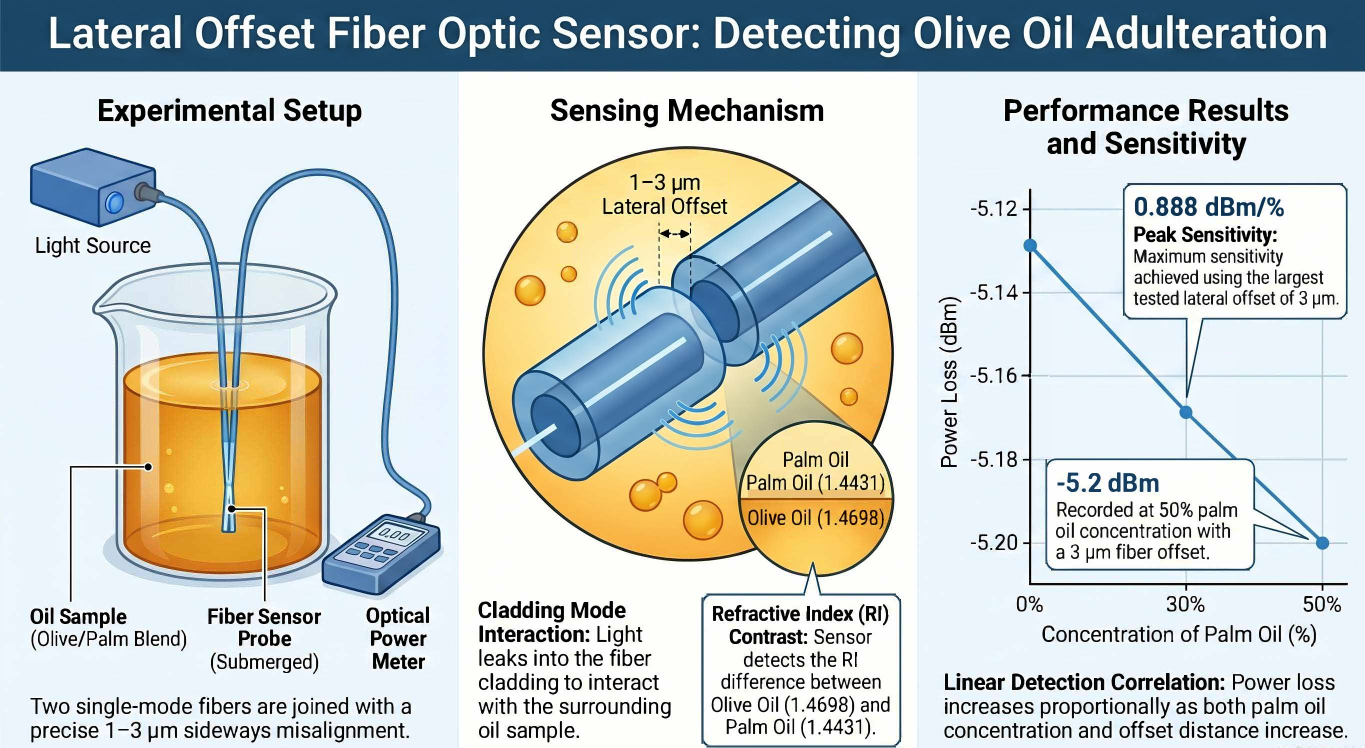
An optical fiber sensor was developed to detect the adulteration of pure olive oil with palm oil using a lateral offset displacement technique. Pure olive oil is a high-quality cooking oil often used in cooking, but its quality degrades due to adulteration. This study employed a single-mode fiber (SMF) displacement sensor, employing lateral offset distances of 1 µm, 2 µm, and 3 µm, to analyze the sensor's response to varying concentrations of palm oil in olive oil, ranging from 10% to 50%. The refractive indices of pure olive and palm oil were initially measured at 1.4698 and 1.4431, respectively, with a proportional decrease in refractive index observed as the concentration of palm oil increased. The maximum sensitivity of 0.888 dBm/% was achieved with a 3 µm lateral offset distance, highlighting the correlation between offset distance and the sensor sensitivity. The power loss increased consistently with higher concentrations of palm oil and greater offset distances, with the highest power loss of -5.2 dBm recorded at 50% adulteration and 3 µm offset. These results underscore the sensor's accuracy and sensitivity in detecting and quantifying adulteration, making it a valuable tool for quality control and ensuring the authenticity of high-value edible oils in the food industry.
References
properties and fatty acid profiles of crude oil extracts from three vegetable seeds. Pakistan Journal of Nutrition, 12(7): 647–650.
Andrew, C., Itodo, A. U., & Etim, E. E. (2012). Thermoxidative degradation of commonly used vegetable oils: a comparative study. Journal of Emerging Trends in Engineering and Applied Sciences, 3(6): 924–928.
Ansari, M. T. I., Raghuwanshi, S. K., Shadab, A., & Kumar, S. (2024). Detection of edible oil adulteration using fiber Bragg grating sensor: a fast and accurate approach. Optical Fibers and Sensors for Medical Diagnostics, Treatment, and Environmental Applications XXIV, 12835: 69–74.
Aparicio, R., Harwood, J. (2013).Handbook of olive oil: 431-478. Springer.
Beyer, R. M., Durán, A. P., Rademacher, T. T., Martin, P., Tayleur, C., Brooks, S. E., Sanderson, F. J. (2020). The environmental impacts of palm oil and its alternatives. Biorxiv.
Bodurov, I., Vlaeva, I., Marudova, M., Yovcheva, T., Nikolova, K., Eftimov, T., & Plachkova, V. (2013). Detection of adulteration in olive oils using optical and thermal methods. In Bulgarian Chemical Communications (Vol. 45).
Boskou, D. (2009). Culinary applications of olive oil—Minor constituents and cooking. Olive oil: Minor constituents and health: 1-4.
Bunaciu, A. A., Fleschin, S., & Aboul-Enein, H. Y. (2022). Determination of some edible oils adulteration with paraffin oil using infrared spectroscopy. Pharmacia, 69: 827-832.
Caramia, G., Gori, A., Valli, E., Cerretani, L. (2012). Virgin olive oil in preventive medicine: From legend to epigenetics. European Journal of Lipid Science and Technology, 114(4): 375-388.
Chauhan, M., Singh, V. K. (2022). ZnO coated evanescent field based fiber optic fuel adulteration sensor. 2022 Workshop on Recent Advances in Photonics (WRAP): 1–2.
Deffense, E. (1985). Fractionation of palm oil. Journal of the American Oil Chemists’ Society, 62(2): 376–385.
Ferdous, A. H. M. I., Anower, M. S., Musha, A., Habib, M. A., Shobug, M. A. (2022). A heptagonal PCF-based oil sensor to detect fuel adulteration using terahertz spectrum. Sensing and Bio-Sensing Research, 36.
Food and Agriculture Organization of the United Nations, World Health Organization. (1981). Codex standard for olive oils and olive pomace oils (Codex Stan 33-1981). Codex Alimentarius.
Food and Agriculture Organization of the United Nations, World Health Organization. (1999). Codex standard for named vegetable oils (Codex Stan 210–1999). Codex Alimentarius.
Girgis, A. Y. (2003). Production of high quality castile soap from high rancid olive oil. Grasas y Aceites, 54(3): 226-233.
Guasch-Ferré, M., Hu, F. B., Martínez-González, M. A., Fitó, M., Bulló, M., Estruch, R., Ros, E., Corella, D., Recondo, J., Gómez-Gracia, E., Fiol, M., Lapetra, J., Serra-Majem, L., Muñoz, M. A., Pintó, X., Lamuela-Raventós, R. M., Basora, J., Buil-Cosiales, P., Sorlí, J. V, Salas-Salvadó, J. (2014). Olive oil intake and risk of cardiovascular disease and mortality in the PREDIMED Study.
Imoisi, O., Ilori, G., Agho, I., Ekhator, J. (2015). Palm oil, its nutritional and health implications (Review). Journal of Applied Sciences and Environmental Management, 19(1): 127.
Jadhav, M. S., Mastiholi, B., Kulkarni, V. K., Lalasangi, A. S., Raikar, U. S. (2022). DETECTION OF ADULTERANT TRACES IN EDIBLE OIL BASED ON FIBER OPTIC SENSOR TECHNOLOGY. In International Journal of Engineering Applied Sciences and Technology (Vol. 7).
Khosroshahi, M. E. (2018). Effect of Temperature on Optical Properties of Vegetable Oils Using UV-Vis and Laser Fluorescence Spectroscopy. Optics and Photonics Journal, 08(07): 247–263.
Liu, J., Zhang, X., Yang, J., Kang, J., Wang, X. (2018). Common difference temperature compensation based fiber refractive index sensor through asymmetrical core-offset splicing. Optics Communications, 427: 261–265.
Li, Y., Fang, T., Zhu, S., Huang, F., Chen, Z., & Wang, Y. (2018). Detection of olive oil adulteration with waste cooking oil via Raman spectroscopy combined with iPLS and SiPLS. Spectrochimica Acta Part A: Molecular and Biomolecular Spectroscopy, 189: 37-43.
Mamat, H., Nor Aini, I., Said, M., Jamaludin, R. (2005). Physicochemical characteristics of palm oil and sunflower oil blends fractionated at different temperatures. Food Chemistry, 91(4): 731–736.
Nocella, C., Cammisotto, V., Fianchini, L., D’Amico, A., Novo, M., Castellani, V., Stefanini, L., Violi, F., Carnevale, R. (2017). Extra Virgin Olive Oil and Cardiovascular Diseases: Benefits for Human Health. Endocrine, Metabolic & Immune Disorders - Drug Targets, 18(1): 4–13.
Padial-Jaudenes, M., Castanys-Munoz, E., Ramirez, M., Lasekan, J. (2020). Physiological impact of palm olein or palm oil in infant formulas: A review of clinical evidence. In Nutrients (Vol. 12, Issue 12: 1–19. MDPI AG.
Puspita, I., Kurniawan, F., Muhamad Hatta, A., Koentjoro, S. (2021). U-bent plastic optical fiber for lard adulteration sensor in edible oil. In Halal Research (Vol. 1).
Rodrigues, F., Pimentel, F. B., Oliveira, M. B. P. (2015). Olive by-products: Challenge application in cosmetic industry. Industrial Crops and Products, 70: 116-124.
Rohman, A., Man, Y. C. (2010). Fourier transform infrared (FTIR) spectroscopy for analysis of extra virgin olive oil adulterated with palm oil. Food research international, 43(3): 886-892.
Srinivasulu, S., Rao, S. V. (2019). Multimode optical fiber extrinsic sensor—Determination of adulteration of certain edible oils. International Journal of Scientific Research and Review, 7(03): 311-318.
Stanciu, I. (2023). Study of the Rheological Behavior of Olive oil at Shear Rates Between 3.3 and 120s-1. Oriental Journal Of Chemistry, 39(1): 126–128.
Tian, R., Zhang, H., Feng, Y., Lu, Q., Chen, Z., Xue, L., Jiang, P., Shi, W., & Yao, J. (2022). Sensitivity-enhanced all-fiber displacement sensor based on Lyot filter. In Proceedings of SPIE: Advanced Sensor Systems and Applications XII (Vol. 12321): 97–102. SPIE.
Xie, C. (2022). Optical Interconnect Technologies for Datacenter Networks. In Datacenter Connectivity Technologies: 1–31. River Publishers.
Zhang, Y., Liu, Y., Shi, B., Han, B., Wang, M., Zhao, Y. (2022). Lateral offset single-mode fiber-based Fabry–Pérot interferometers with Vernier effect for hydrogen sensing. Analytical Chemistry, 95(2): 872–880.
Downloads
Published
Issue
Section
License
Copyright (c) 2026 Malaysian Journal of Science (MJS)

This work is licensed under a Creative Commons Attribution-NonCommercial 4.0 International License.
Transfer of Copyrights
- In the event of publication of the manuscript entitled [INSERT MANUSCRIPT TITLE AND REF NO.] in the Malaysian Journal of Science, I hereby transfer copyrights of the manuscript title, abstract and contents to the Malaysian Journal of Science and the Faculty of Science, University of Malaya (as the publisher) for the full legal term of copyright and any renewals thereof throughout the world in any format, and any media for communication.
Conditions of Publication
- I hereby state that this manuscript to be published is an original work, unpublished in any form prior and I have obtained the necessary permission for the reproduction (or am the owner) of any images, illustrations, tables, charts, figures, maps, photographs and other visual materials of whom the copyrights is owned by a third party.
- This manuscript contains no statements that are contradictory to the relevant local and international laws or that infringes on the rights of others.
- I agree to indemnify the Malaysian Journal of Science and the Faculty of Science, University of Malaya (as the publisher) in the event of any claims that arise in regards to the above conditions and assume full liability on the published manuscript.
Reviewer’s Responsibilities
- Reviewers must treat the manuscripts received for reviewing process as confidential. It must not be shown or discussed with others without the authorization from the editor of MJS.
- Reviewers assigned must not have conflicts of interest with respect to the original work, the authors of the article or the research funding.
- Reviewers should judge or evaluate the manuscripts objective as possible. The feedback from the reviewers should be express clearly with supporting arguments.
- If the assigned reviewer considers themselves not able to complete the review of the manuscript, they must communicate with the editor, so that the manuscript could be sent to another suitable reviewer.
Copyright: Rights of the Author(s)
- Effective 2007, it will become the policy of the Malaysian Journal of Science (published by the Faculty of Science, University of Malaya) to obtain copyrights of all manuscripts published. This is to facilitate:
- Protection against copyright infringement of the manuscript through copyright breaches or piracy.
- Timely handling of reproduction requests from authorized third parties that are addressed directly to the Faculty of Science, University of Malaya.
- As the author, you may publish the fore-mentioned manuscript, whole or any part thereof, provided acknowledgement regarding copyright notice and reference to first publication in the Malaysian Journal of Science and Faculty of Science, University of Malaya (as the publishers) are given. You may produce copies of your manuscript, whole or any part thereof, for teaching purposes or to be provided, on individual basis, to fellow researchers.
- You may include the fore-mentioned manuscript, whole or any part thereof, electronically on a secure network at your affiliated institution, provided acknowledgement regarding copyright notice and reference to first publication in the Malaysian Journal of Science and Faculty of Science, University of Malaya (as the publishers) are given.
- You may include the fore-mentioned manuscript, whole or any part thereof, on the World Wide Web, provided acknowledgement regarding copyright notice and reference to first publication in the Malaysian Journal of Science and Faculty of Science, University of Malaya (as the publishers) are given.
- In the event that your manuscript, whole or any part thereof, has been requested to be reproduced, for any purpose or in any form approved by the Malaysian Journal of Science and Faculty of Science, University of Malaya (as the publishers), you will be informed. It is requested that any changes to your contact details (especially e-mail addresses) are made known.
Copyright: Role and responsibility of the Author(s)
- In the event of the manuscript to be published in the Malaysian Journal of Science contains materials copyrighted to others prior, it is the responsibility of current author(s) to obtain written permission from the copyright owner or owners.
- This written permission should be submitted with the proof-copy of the manuscript to be published in the Malaysian Journal of Science
Licensing Policy
Malaysian Journal of Science is an open-access journal that follows the Creative Commons Attribution-Non-commercial 4.0 International License (CC BY-NC 4.0)
CC BY – NC 4.0: Under this licence, the reusers to distribute, remix, alter, and build upon the content in any media or format for non-commercial purposes only, as long as proper acknowledgement is given to the authors of the original work. Please take the time to read the whole licence agreement (https://creativecommons.org/licenses/by-nc/4.0/legalcode ).