In Silico Characterization of Selected Carbohydrate Active Enzymes (CAZymes) from Malaysia's Unique Genome Assemblies Through Genomic Data Mining
DOI:
https://doi.org/10.22452/Keywords:
CAZymes, In-silico Protein Modeling, Genomic Data MiningAbstract
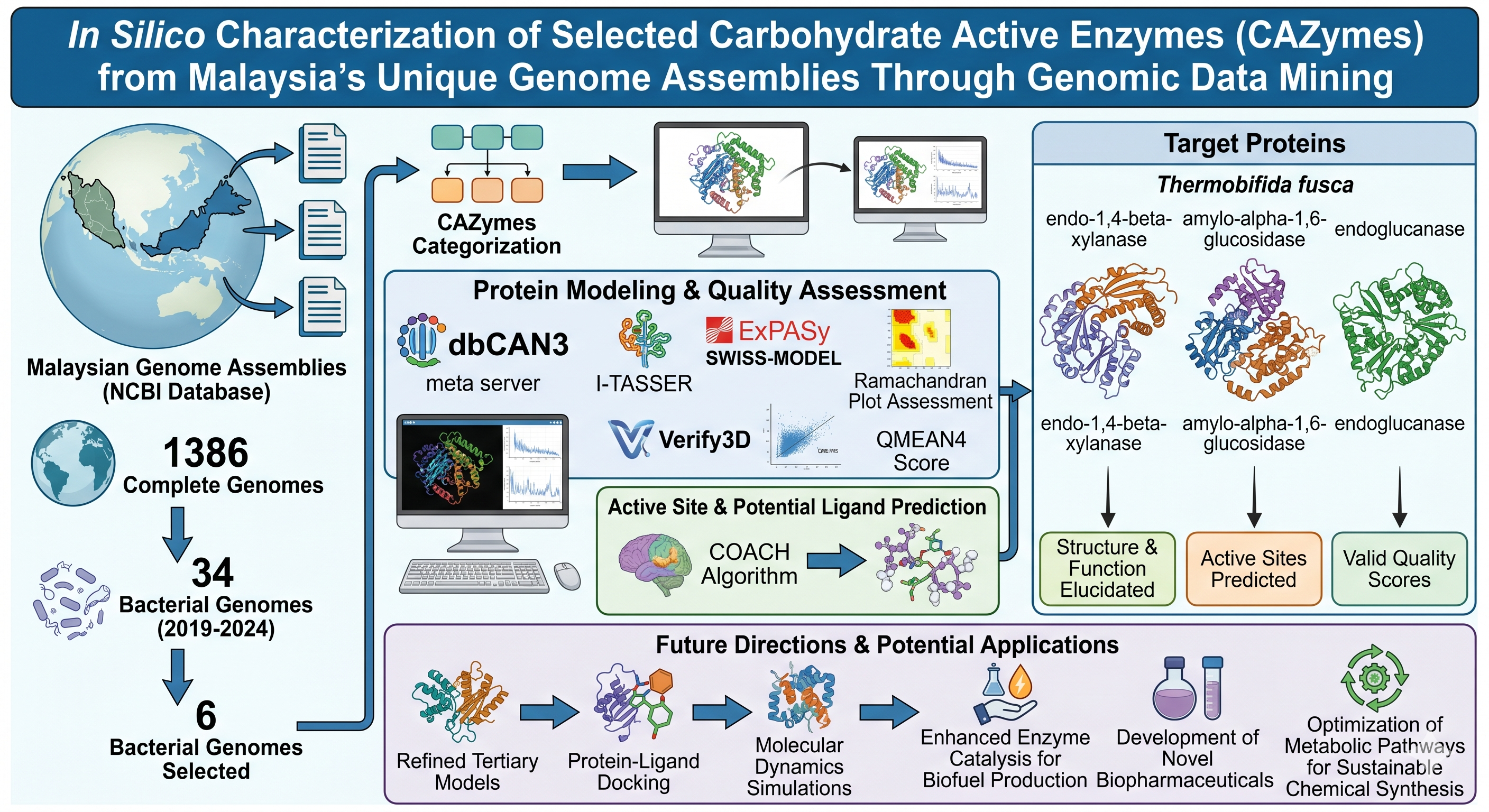
In silico characterization of protein is usually performed to elucidate the structure and function of protein targets prior to experimental approach, which helps to narrow down target candidates, and reduce overall time, cost and effort. Carbohydrate-active enzymes (CAZymes) are enzymes involved in conversion of biomass to industrially valuable products. More research is needed to characterise CAZymes from Malaysia. This study aims to elucidate CAZymes from selected genome assemblies isolated in Malaysia by in silico genomic data mining. The National Center for Biotechnology Information database is utilized to investigate Malaysia's genome assemblies, discovering 1386 complete genomes. From 2019 to 2024, there are 34 bacterial genomes isolated by Malaysian researchers. CAZymes from six bacterial genomes were categorised. Three CAZymes from Thermobifida fusca were chosen for subsequent protein modelling due to their acceptable homology range to available protein structures. To characterise the structural and functional properties of these CAZymes, online protein modelling tools were used (dbCAN3 meta server, I-TASSER and ExPASy SWISS-MODEL), as well as to evaluate the quality of the protein models (Ramachandran plot assessment, Verify3D and QMEAN4 score). Then, the ligand-binding sites inside each CAZyme sequence were predicted using I-TASSER’s COACH algorithm. Three target CAZymes annotated as endo-1,4-beta-xylanase, amylo-alpha-1,6-glucosidase and endoglucanase respectively have been modelled, their protein model assessed for its quality, and their active sites and potential ligand predicted. Through in-silico characterization, the proteins’ structure and function have been elucidated. Future studies, employing refined tertiary models, protein-ligand docking, and molecular dynamics simulations, aim to identify novel inhibitors or activators. This will facilitate experimental validation and unlock diverse industrial biotechnology applications. Potential benefits include enhanced enzyme catalysis for biofuel production, development of novel biopharmaceuticals, and optimization of metabolic pathways for sustainable chemical synthesis. These findings could significantly impact industrial processes and contribute to bio-based economies.
References
Bains, R. K., Nasseri, S. A., Wardman, J. F., & Withers, S. G. (2024). Advances in the understanding and exploitation of carbohydrate-active enzymes, Current Opinion in Chemical Biology, 80, 102457.
Godse, R., Bawane, H., Tripathi, J., & Kulkarni, R. (2021). Unconventional β-glucosidases: a promising biocatalyst for industrial biotechnology, Applied Biochemistry and Biotechnology, 193, 2993-3016.
Lee, J. Y., Tsolis, R. M., & Bäumler, A. J. (2022). The microbiome and gut homeostasis. Science, 377(6601), eabp9960.
Liew, K. J., Lim, L., Woo, H. Y., Chan, K. G., Shamsir, M. S., & Goh, K. M. (2018). Purification and characterization of a novel GH1 beta-glucosidase from Jeotgalibacillus malaysiensis. International Journal of Biological Macromolecules, 115, 1094-1102.
Nargotra, P., Sharma, V., Lee, Y. C., Tsai, Y. H., Liu, Y. C., Shieh, C. J., ... & Kuo, C. H. (2022). Microbial lignocellulolytic enzymes for the effective valorization of lignocellulosic biomass: a review, Catalysts, 13(1), 83.
Nooraisyah, M. N., Siti Nur Hasanah, M. Y., Mahadi, N. M., Abu Bakar, F. D., & Murad, A. M. A. (2015). Genome Mining For Glycoside Hydrolases From The Psychrophilic Yeast Glaciozyma Antarctica PI12, Malaysian Applied Biology, 44(1).
Nin-Hill, A., Piniello, B., & Rovira, C. (2023). In silico modelling of the function of disease-related CAZymes, Essays in Biochemistry, 67(3), 355-372.
Sayers, E. W., Bolton, E. E., Brister, J. R., Canese, K., Chan, J., Comeau, D. C., Connor, R., Funk, K., Kelly, C., Kim, S., Madej, T., Marchler-Bauer, A., Lanczycki, C., Lathrop, S., Lu, Z., Thibaud-Nissen, F., Murphy, T., Phan, L., Skripchenko, Y., Tse, T., … Sherry, S. T. (2022). Database resources of the national center for biotechnology information, Nucleic acids research, 50(D1), D20–D26. https://doi.org/10.1093/nar/gkab1112
Sharkey, T. D. (2024). The end game (s) of photosynthetic carbon metabolism, Plant Physiology, 195(1), 67-78.
Wang, Y., Wang, C., Chen, Y., Cui, M., Wang, Q., & Guo, P. (2022). Heterologous expression of a thermostable α-galactosidase from Parageobacillus thermoglucosidasius isolated from the lignocellulolytic microbial consortium TMC7, Journal of Microbiology and Biotechnology, 32(6), 749.
Waterhouse, A. M., Studer, G., Robin, X., Bienert, S., Tauriello, G., & Schwede, T. (2024). The structure assessment web server: for proteins, complexes and more, Nucleic Acids Research, gkae270.
Wardman, J. F., Bains, R. K., Rahfeld, P., & Withers, S. G. (2022). Carbohydrate-active enzymes (CAZymes) in the gut microbiome, Nature Reviews Microbiology, 20(9), 542-556.
Yang, Q., Chang, S., Zhang, X., Luo, F., Li, W., & Ren, J. (2024). The fate of dietary polysaccharides in the digestive tract, Trends in Food Science & Technology, 104606.
Ye, S., Shah, B. R., Li, J., Liang, H., Zhan, F., Geng, F., & Li, B. (2022). A critical review on interplay between dietary fibers and gut microbiota, Trends in Food Science & Technology, 124, 237-249.
Yildiz, S. Y., Finore, I., Leone, L., Romano, I., Lama, L., Kasavi, C., Nicolaus, B., Oner, E. T., & Poli, A. (2022). Genomic Analysis Provides New Insights Into Biotechnological and Industrial Potential of Parageobacillus thermantarcticus M1, Frontiers in Microbiology, 13. https://doi.org/10.3389/fmicb.2022.923038
Zhang, H., Yohe, T., Huang, L., Entwistle, S., Wu, P., Yang, Z., Peter Kamp Busk, Xu, Y., & Yin, Y. (2018). dbCAN2: a meta server for automated carbohydrate-active enzyme annotation, Nucleic Acids Research, 46(W1), W95–W101.
Zheng, J., Ge, Q., Yan, Y., Zhang, X., Huang, L., & Yin, Y. (2023). dbCAN3: automated carbohydrate-active enzyme and substrate annotation, Nucleic Acids Research, 51(W1), W115-W121.
Zhou, X., Zheng, W., Li, Y., Pearce, R., Zhang, C., Bell, E. W., ... & Zhang, Y. (2022). I-TASSER-MTD: a deep-learning-based platform for multi-domain protein structure and function prediction, Nature Protocols, 17(10), 2326-2353.
Downloads
Published
Issue
Section
License
Copyright (c) 2026 Malaysian Journal of Science (MJS)

This work is licensed under a Creative Commons Attribution-NonCommercial 4.0 International License.
Transfer of Copyrights
- In the event of publication of the manuscript entitled [INSERT MANUSCRIPT TITLE AND REF NO.] in the Malaysian Journal of Science, I hereby transfer copyrights of the manuscript title, abstract and contents to the Malaysian Journal of Science and the Faculty of Science, University of Malaya (as the publisher) for the full legal term of copyright and any renewals thereof throughout the world in any format, and any media for communication.
Conditions of Publication
- I hereby state that this manuscript to be published is an original work, unpublished in any form prior and I have obtained the necessary permission for the reproduction (or am the owner) of any images, illustrations, tables, charts, figures, maps, photographs and other visual materials of whom the copyrights is owned by a third party.
- This manuscript contains no statements that are contradictory to the relevant local and international laws or that infringes on the rights of others.
- I agree to indemnify the Malaysian Journal of Science and the Faculty of Science, University of Malaya (as the publisher) in the event of any claims that arise in regards to the above conditions and assume full liability on the published manuscript.
Reviewer’s Responsibilities
- Reviewers must treat the manuscripts received for reviewing process as confidential. It must not be shown or discussed with others without the authorization from the editor of MJS.
- Reviewers assigned must not have conflicts of interest with respect to the original work, the authors of the article or the research funding.
- Reviewers should judge or evaluate the manuscripts objective as possible. The feedback from the reviewers should be express clearly with supporting arguments.
- If the assigned reviewer considers themselves not able to complete the review of the manuscript, they must communicate with the editor, so that the manuscript could be sent to another suitable reviewer.
Copyright: Rights of the Author(s)
- Effective 2007, it will become the policy of the Malaysian Journal of Science (published by the Faculty of Science, University of Malaya) to obtain copyrights of all manuscripts published. This is to facilitate:
- Protection against copyright infringement of the manuscript through copyright breaches or piracy.
- Timely handling of reproduction requests from authorized third parties that are addressed directly to the Faculty of Science, University of Malaya.
- As the author, you may publish the fore-mentioned manuscript, whole or any part thereof, provided acknowledgement regarding copyright notice and reference to first publication in the Malaysian Journal of Science and Faculty of Science, University of Malaya (as the publishers) are given. You may produce copies of your manuscript, whole or any part thereof, for teaching purposes or to be provided, on individual basis, to fellow researchers.
- You may include the fore-mentioned manuscript, whole or any part thereof, electronically on a secure network at your affiliated institution, provided acknowledgement regarding copyright notice and reference to first publication in the Malaysian Journal of Science and Faculty of Science, University of Malaya (as the publishers) are given.
- You may include the fore-mentioned manuscript, whole or any part thereof, on the World Wide Web, provided acknowledgement regarding copyright notice and reference to first publication in the Malaysian Journal of Science and Faculty of Science, University of Malaya (as the publishers) are given.
- In the event that your manuscript, whole or any part thereof, has been requested to be reproduced, for any purpose or in any form approved by the Malaysian Journal of Science and Faculty of Science, University of Malaya (as the publishers), you will be informed. It is requested that any changes to your contact details (especially e-mail addresses) are made known.
Copyright: Role and responsibility of the Author(s)
- In the event of the manuscript to be published in the Malaysian Journal of Science contains materials copyrighted to others prior, it is the responsibility of current author(s) to obtain written permission from the copyright owner or owners.
- This written permission should be submitted with the proof-copy of the manuscript to be published in the Malaysian Journal of Science
Licensing Policy
Malaysian Journal of Science is an open-access journal that follows the Creative Commons Attribution-Non-commercial 4.0 International License (CC BY-NC 4.0)
CC BY – NC 4.0: Under this licence, the reusers to distribute, remix, alter, and build upon the content in any media or format for non-commercial purposes only, as long as proper acknowledgement is given to the authors of the original work. Please take the time to read the whole licence agreement (https://creativecommons.org/licenses/by-nc/4.0/legalcode ).