Mode-Locked Based on Side-Polished Fiber Coated with Gold as a Medium for the Temperature Sensor
DOI:
https://doi.org/10.22452/Keywords:
Gold nanoparticle, Fiber laser, Mode-locked, Side-polished fiber, Temperature sensorAbstract
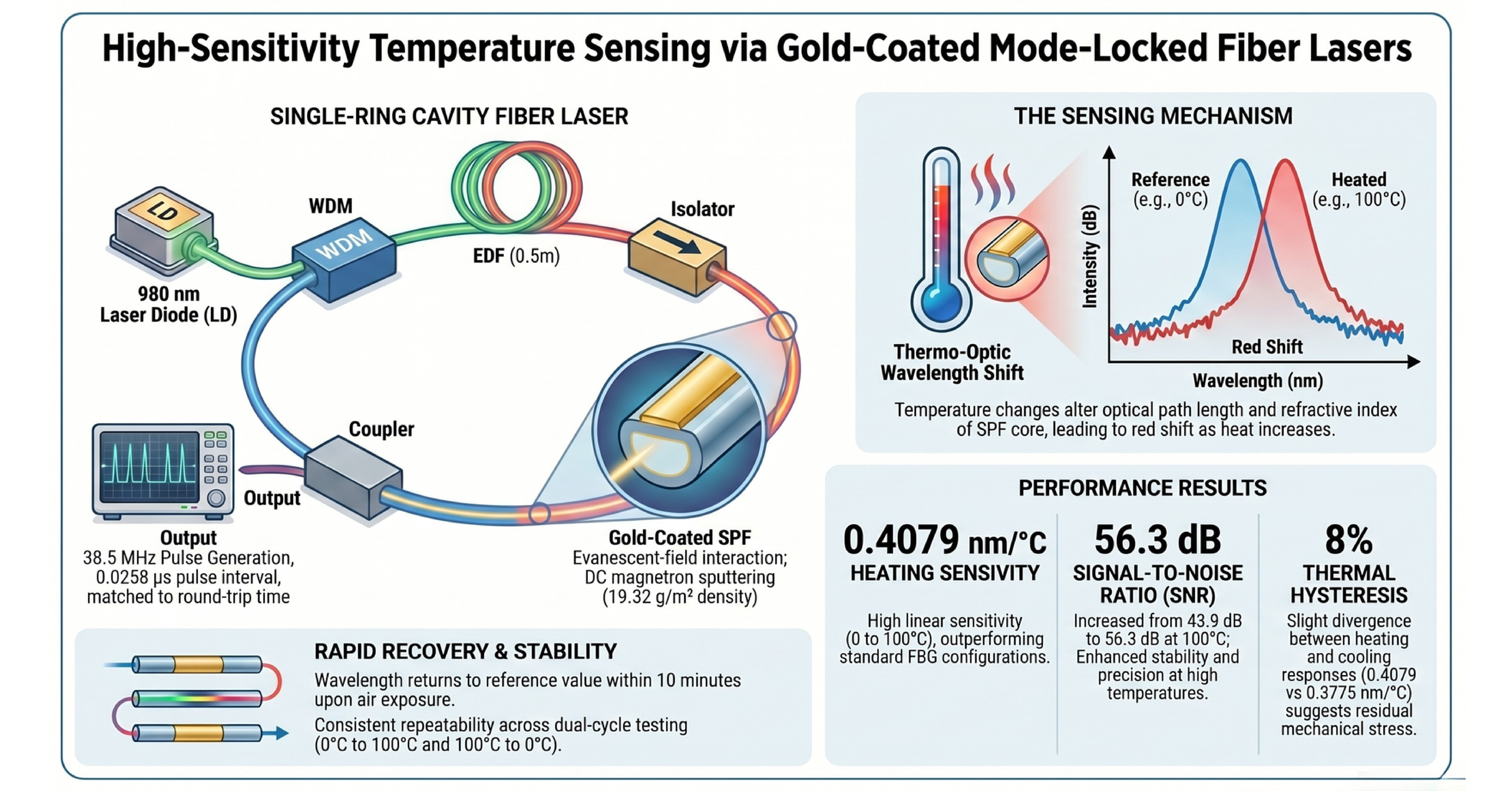
We present a mode-locked based on side-polished fiber (SPF) as a medium for temperature sensing. To develop a mode-locked fiber sensor (MLFS), an erbium-doped fiber and gold nanoparticles with 10 nm thickness were coated onto SPF. An MLFS pulse was generated at 38.5 MHz with a pulse interval of 0.0258 µs, matching the cavity round-trip time. The sensing part was tested under two conditions: heating (100 to 0 °C) and cooling (0 to 100 °C). The experiment revealed a linear relationship between the resonant wavelength shift and temperature variations, with sensitivities of 0.4079 and 0.3775 nm °C⁻¹ during heating and cooling, respectively. The SNR value increased from 43.9 to 56.3 dB, indicating stable output power precision. Moreover, the incorporation of a gold-nanoparticle coating on SPF improved sensor sensitivity and reliability while reducing the effects of external variables such as moisture and vibration. These properties also describe the sensor's strength and adaptability in demanding industrial and commercial applications. Future research will focus on assessing long-term performance under changing environmental conditions, thereby ensuring dependability across varied contexts.
References
Arjmand, M., Saghafifar, H., Alijanianzadeh, M., & Soltanolkotabi, M. (2017). A sensitive tapered-fiber optic biosensor for the label-free detection of organophosphate pesticides. Sensors and Actuators B: Chemical, 249, 523-532.
Bai, Y., Yan, F., Feng, T., Han, W., Zhang, L., Cheng, D., ... & Wen, X. (2019). Temperature fiber sensor based on single longitudinal mode fiber laser in 2 μm band with Sagnac interferometer. Optical Fiber Technology, 51, 71-76.
Bolshtyansky, M., Wysocki, P., & Conti, N. (2000). Model of temperature dependence for gain shape of erbium-doped fiber amplifier. Journal of lightwave technology, 18(11), 1533.
Cao, H., & Shu, X. (2017). Miniature all-fiber high temperature sensor based on Michelson interferometer formed with a novel core-mismatching fiber joint. IEEE Sensors Journal, 17(11), 3341-3345.
Chen, F., Jiang, Y., Zhang, L., Jiang, L., & Wang, S. (2018). Fiber optic refractive index and magnetic field sensors based on microhole-induced inline Mach–Zehnder interferometers. Measurement Science and Technology, 29(4), 045103.
Chou, Y. L., Wu, C. W., Jhang, R. T., & Chiang, C. C. (2019). A novel optical fiber temperature sensor with polymer-metal alternating structure. Optics & Laser Technology, 115, 186-192.
Fried, N. M. (2005). Thulium fiber laser lithotripsy: An in vitro analysis of stone fragmentation using a modulated 110‐watt Thulium fiber laser at 1.94 µm. Lasers in Surgery and Medicine: The Official Journal of the American Society for Laser Medicine and Surgery, 37(1), 53-58.
Fu, X., Zhang, Y., Wang, Y., Fu, G., Jin, W., & Bi, W. (2020). A temperature sensor based on tapered few mode fiber long-period grating induced by CO2 laser and fusion tapering. Optics & Laser Technology, 121, 105825.
Ganeev, R. A. (2019). Characterization of the optical nonlinearities of silver and gold nanoparticles. Optics and Spectroscopy, 127(3), 487-507.
Gonzalez-Reyna, M. A., Alvarado-Mendez, E., Estudillo-Ayala, J. M., Vargas-Rodriguez, E., Sosa-Morales, M. E., Sierra-Hernandez, J. M., & Rojas-Laguna, R. (2015). Laser temperature sensor based on a fiber Bragg grating. IEEE Photonics Technology Letters, 27(11), 1141-1144.
Grobnic, D., Smelser, C. W., Mihailov, S. J., & Walker, R. B. (2006). Long-term thermal stability tests at 1000 C of silica fibre Bragg gratings made with ultrafast laser radiation. Measurement Science and Technology, 17(5), 1009.
Huang, Y., Zhu, W., Li, Z., Chen, G., Chen, L., Zhou, J., & Yu, J. (2018). High-performance fibre-optic humidity sensor based on a side-polished fibre wavelength selectively coupled with graphene oxide film. Sensors and actuators B: chemical, 255, 57-69.
Jachpure, D., Prakash, O., & Vijaya, R. (2024). Saturable absorption in erbium-doped fiber for controlling lasing peaks and their linewidths in fiber laser. Optical Fiber Technology, 88, 104022.
Jung, M., Lee, J., Koo, J., Park, J., Song, Y. W., Lee, K., & Lee, J. H. (2014). A femtosecond pulse fiber laser at 1935 nm using a bulk-structured Bi 2 Te 3 topological insulator. Optics express, 22(7), 7865-7874.
Kieu, K. Q., & Mansuripur, M. (2006). Biconical fiber taper sensors. IEEE photonics technology letters, 18(21), 2239-2241.
Keller, U. (2000, September). Ultrafast solid-state lasers. In The European Conference on Lasers and Electro-Optics (p. CMB3). Optica Publishing Group.
Li, X., Xu, W., Wang, Y., Zhang, X., Hui, Z., Zhang, H., & Al-Sehemi, A. G. (2022). Optical-intensity modulators with PbTe thermoelectric nanopowders for ultrafast photonics. Applied Materials Today, 28, 101546.
Li, J., Wu, J., Hao, Q., Huang, K., Yang, K., & Zeng, H. (2023). Wavelength and repetition rate tunable high peak power dissipative soliton resonance in an all polarization maintaining Yb-doped fiber laser. Optics & Laser Technology, 162, 109204.
Lu, L., Liang, Z., Wu, L., Chen, Y., Song, Y., Dhanabalan, S. C., & Zhang, H. (2018). Few‐layer bismuthene: sonochemical exfoliation, non-linear optics and applications for ultrafast photonics with enhanced stability. Laser & Photonics Reviews, 12(1), 1700221.
Lu, Z., Liu, C., Li, C., Ren, J., & Yang, L. (2023). Ultra-High Sensitivity and Temperature-Insensitive Optical Fiber Strain Sensor Based on Dual Air Cavities. Materials, 16(8), 3165.
Lin, Y., Gong, Y., Wu, Y., & Wu, H. (2015). Polyimide-coated fiber Bragg grating for relative humidity sensing. Photonic sensors, 5, 60-66.
Lin, Q., Hu, Y., Yan, F., Hu, S., Chen, Y., Liu, G., & Chen, Z. (2020). Half-side gold-coated hetero-core fiber for highly sensitive measurement of a vector magnetic field. Optics Letters, 45(17), 4746-4749.
Luo, W., Li, X., Meng, J., Wang, Y., & Hong, X. (2021). Surface plasmon resonance sensor based on side-polished D-shaped photonic crystal fiber with split cladding air holes. IEEE Transactions on Instrumentation and Measurement, 70, 1-11.
Liao, H. B., Xiao, R. F., Fu, J. S., Yu, P., Wong, G. K. L., & Sheng, P. (1997). Large third-order optical nonlinearity in Au: Si O 2 composite films near the percolation threshold. Applied Physics Letters, 70(1), 1-3.
Mądry, M., Alwis, L., Binetti, L., Pajewski, Ł., & Bereś-Pawlik, E. (2019). Simultaneous measurement of temperature and relative humidity using a dual-wavelength erbium-doped fiber ring laser sensor. IEEE Sensors Journal, 19(20), 9215-9220.
Matsas, V. J., Newson, T. P., Richardson, D. J., & Payne, D. N. (1992). Self-starting, passively mode-locked fibre ring soliton laser exploiting non-linear polarisation rotation. Electronics Letters, 28(15), 1391-1393.
Mahmud, N. N. H. E. N., Awang, N. A., & Zulkefli, N. U. H. H. (2022). Supercontinuum generation of gold coated side-polished fiber based-mode-locked pulse. Optik, 260, 169074.
Mahmud, N. N. H. E. N., Awang, N. A., Zalkepali, N. U. H. H., Latif, A. A., Muhammad, N. A. M., & Zamri, A. Z. M. (2023). The influence of Au-NP thickness coated on side-polished fiber on the properties of mode-locked erbium-doped fiber laser. Infrared Physics & Technology, 130, 104616.
Novoselov, K. S., Geim, A. K., Morozov, S. V., Jiang, D., Katsnelson, M. I., Grigorieva, I. V., & Firsov, A. A. (2005). Two-dimensional gas of massless Dirac fermions in graphene. Nature, 438(7065), 197-200.M.
Senosiain, J., Díaz, I., Gastón, A., & Sevilla, J. (2002). High sensitivity temperature sensor based on side-polished optical fiber. IEEE Transactions on Instrumentation and measurement, 50(6), 1656-1660.
Sun, Z., Hasan, T., Torrisi, F., Popa, D., Privitera, G., Wang, F., & Ferrari, A. C. (2010). Graphene mode-locked ultrafast laser. ACS nano, 4(2), 803-810.
Song, H., Wang, Q., Zhang, Y., & Li, L. (2017). Mode-locked ytterbium-doped all-fiber lasers based on few-layer black phosphorus saturable absorbers. Optics Communications, 394, 157-160.
Sharma, A. K., & Gupta, B. D. (2006). Influence of temperature on the sensitivity and signal-to-noise ratio of a fiber-optic surface-plasmon resonance sensor. Applied optics, 45(1), 151-161.
Stewart, G., Culshaw, B., Johnstone, W., Whitenett, G., Atherton, K., & McLean, A. (2003). Optical fibre sensors and networks for environmental monitoring. Management of Environmental Quality: An International Journal, 14(2), 181-190.
Teng, C., Shao, P., Li, S., Li, S., Liu, H., Deng, H., & Deng, S. (2022). Double-side polished U-shape plastic optical fiber based SPR sensor for the simultaneous measurement of refractive index and temperature. Optics communications, 525, 128844.
Trushin, M., Kelleher, E. J., & Hasan, T. (2016). Theory of edge-state optical absorption in two-dimensional transition metal dichalcogenide flakes. Physical Review B, 94(15), 155301.
Viegas, D., Goicoechea, J., Santos, J. L., Araújo, F. M., Ferreira, L. A., Arregui, F. J., & Matias, I. R. (2009). Sensitivity improvement of a humidity sensor based on silica nanospheres on a long-period fiber grating. Sensors, 9(1), 519-527.
Wu, W., & Liu, X. (2015). Investigation on high temperature characteristics of FBG sensors. Optik, 126(20), 2411-2413.
Wang, X., Sun, X., Hu, Y., Zeng, L., Liu, Q., & Duan, J. A. (2022). Highly-sensitive fiber Bragg grating temperature sensors with metallic coatings. Optik, 262, 169337.
Zhou, H. S., Honma, I., Komiyama, H., & Haus, J. W. (1994). Controlled synthesis and quantum-size effect in gold-coated nanoparticles. Physical Review B, 50(16), 12052.
Zhang, Y., Jin, W., Yu, H. B., Zhang, M., Liao, Y. B., Ho, H. L., & Li, Y. H. (2002). Novel intracavity sensing network based on mode-locked fiber laser. IEEE Photonics Technology Letters, 14(9), 1336-1338.
Zainuddin, N. A. A. M., Ariannejad, M. M., Arasu, P. T., Harun, S. W., & Zakaria, R. (2019). Investigation of cladding thicknesses on silver SPR based side-polished optical fiber refractive-index sensor. Results in Physics, 13, 102255.
Downloads
Published
Issue
Section
License
Copyright (c) 2026 Malaysian Journal of Science (MJS)

This work is licensed under a Creative Commons Attribution-NonCommercial 4.0 International License.
Transfer of Copyrights
- In the event of publication of the manuscript entitled [INSERT MANUSCRIPT TITLE AND REF NO.] in the Malaysian Journal of Science, I hereby transfer copyrights of the manuscript title, abstract and contents to the Malaysian Journal of Science and the Faculty of Science, University of Malaya (as the publisher) for the full legal term of copyright and any renewals thereof throughout the world in any format, and any media for communication.
Conditions of Publication
- I hereby state that this manuscript to be published is an original work, unpublished in any form prior and I have obtained the necessary permission for the reproduction (or am the owner) of any images, illustrations, tables, charts, figures, maps, photographs and other visual materials of whom the copyrights is owned by a third party.
- This manuscript contains no statements that are contradictory to the relevant local and international laws or that infringes on the rights of others.
- I agree to indemnify the Malaysian Journal of Science and the Faculty of Science, University of Malaya (as the publisher) in the event of any claims that arise in regards to the above conditions and assume full liability on the published manuscript.
Reviewer’s Responsibilities
- Reviewers must treat the manuscripts received for reviewing process as confidential. It must not be shown or discussed with others without the authorization from the editor of MJS.
- Reviewers assigned must not have conflicts of interest with respect to the original work, the authors of the article or the research funding.
- Reviewers should judge or evaluate the manuscripts objective as possible. The feedback from the reviewers should be express clearly with supporting arguments.
- If the assigned reviewer considers themselves not able to complete the review of the manuscript, they must communicate with the editor, so that the manuscript could be sent to another suitable reviewer.
Copyright: Rights of the Author(s)
- Effective 2007, it will become the policy of the Malaysian Journal of Science (published by the Faculty of Science, University of Malaya) to obtain copyrights of all manuscripts published. This is to facilitate:
- Protection against copyright infringement of the manuscript through copyright breaches or piracy.
- Timely handling of reproduction requests from authorized third parties that are addressed directly to the Faculty of Science, University of Malaya.
- As the author, you may publish the fore-mentioned manuscript, whole or any part thereof, provided acknowledgement regarding copyright notice and reference to first publication in the Malaysian Journal of Science and Faculty of Science, University of Malaya (as the publishers) are given. You may produce copies of your manuscript, whole or any part thereof, for teaching purposes or to be provided, on individual basis, to fellow researchers.
- You may include the fore-mentioned manuscript, whole or any part thereof, electronically on a secure network at your affiliated institution, provided acknowledgement regarding copyright notice and reference to first publication in the Malaysian Journal of Science and Faculty of Science, University of Malaya (as the publishers) are given.
- You may include the fore-mentioned manuscript, whole or any part thereof, on the World Wide Web, provided acknowledgement regarding copyright notice and reference to first publication in the Malaysian Journal of Science and Faculty of Science, University of Malaya (as the publishers) are given.
- In the event that your manuscript, whole or any part thereof, has been requested to be reproduced, for any purpose or in any form approved by the Malaysian Journal of Science and Faculty of Science, University of Malaya (as the publishers), you will be informed. It is requested that any changes to your contact details (especially e-mail addresses) are made known.
Copyright: Role and responsibility of the Author(s)
- In the event of the manuscript to be published in the Malaysian Journal of Science contains materials copyrighted to others prior, it is the responsibility of current author(s) to obtain written permission from the copyright owner or owners.
- This written permission should be submitted with the proof-copy of the manuscript to be published in the Malaysian Journal of Science
Licensing Policy
Malaysian Journal of Science is an open-access journal that follows the Creative Commons Attribution-Non-commercial 4.0 International License (CC BY-NC 4.0)
CC BY – NC 4.0: Under this licence, the reusers to distribute, remix, alter, and build upon the content in any media or format for non-commercial purposes only, as long as proper acknowledgement is given to the authors of the original work. Please take the time to read the whole licence agreement (https://creativecommons.org/licenses/by-nc/4.0/legalcode ).