Predictive Lead Scoring Models: A Contemporary Review of Identified Gaps and Future Directions
DOI:
https://doi.org/10.22452/Keywords:
Lead Scoring, Machine Learning, Artificial Neural Networks, Deep Learning, Social MediaAbstract
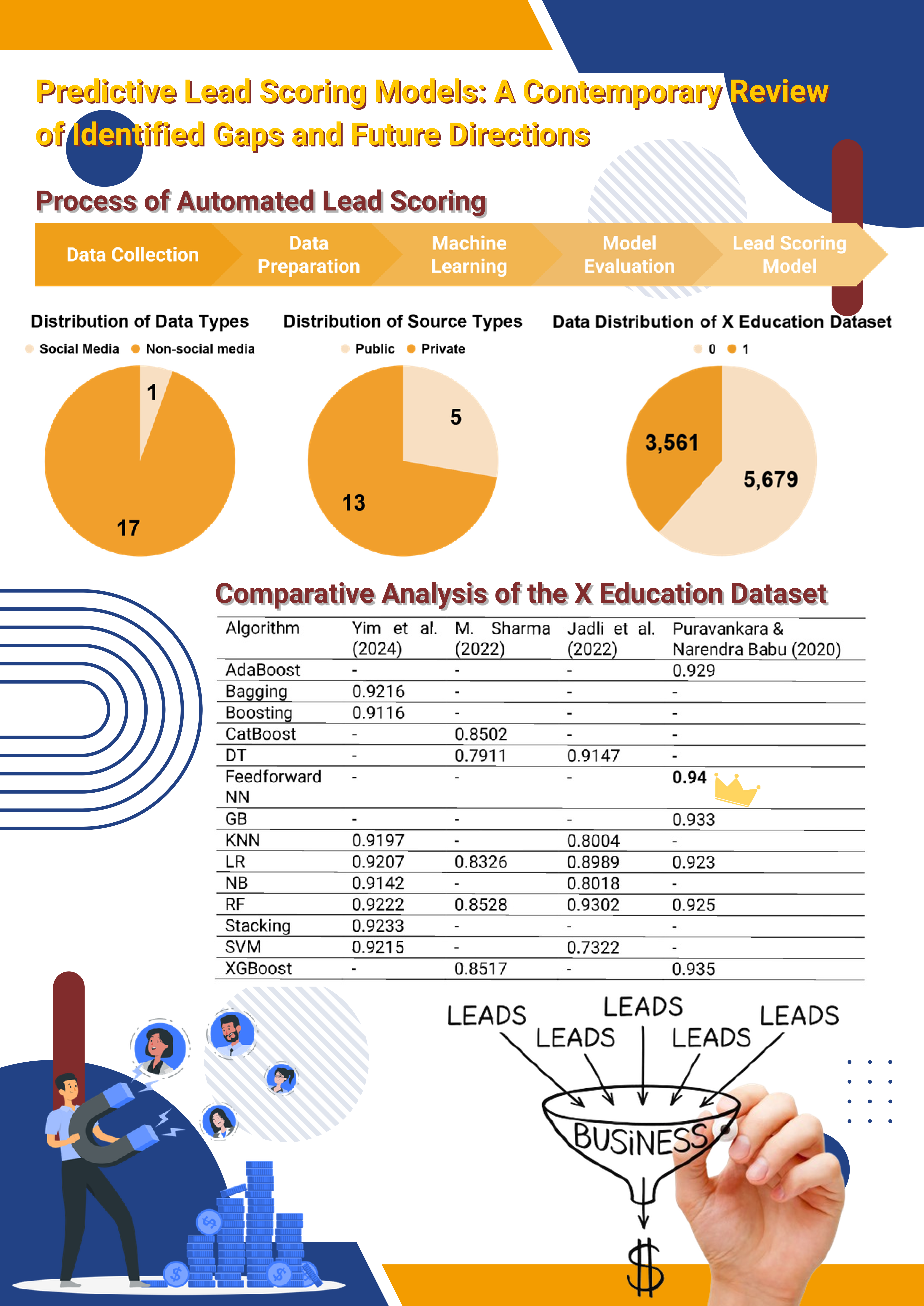
Lead scoring plays a pivotal role in modern marketing strategies, aiding businesses in prioritising and optimising their sales efforts. This review paper provides a contemporary analysis of lead scoring models, focusing on their development, application, and effectiveness across Machine Learning algorithms. The paper begins by introducing the concept and evolution of lead scoring, highlighting the shift in how previous researchers developed lead scoring models, from traditional Machine Learning algorithms to more advanced approaches, such as Ensemble Learning, Neural Networks, and Deep Learning algorithms. It also addresses existing gaps in current models and clarifies the misconceptions about the definition of “lead scoring”. In addition, the paper reviews the methodologies used in lead scoring, including data collection, feature selection, and the algorithms applied. Finally, it examines emerging trends and challenges in lead scoring, offering an insightful overview of the current landscape and suggesting future research directions to unlock new opportunities for businesses to enhance their marketing strategies.
References
Abdel-Nasser Sharkawy. (2020). Principle of Neural Network and Its Main Types: Review. Journal of Advances in Applied & Computational Mathematics, 7, 8–19. https://doi.org/10.15377/2409-5761.2020.07.2
Akkem, Y., Biswas, S. K., & Varanasi, A. (2024). A comprehensive review of synthetic data generation in smart farming by using variational autoencoder and generative adversarial network. Engineering Applications of Artificial Intelligence, 131, 107881. https://doi.org/10.1016/J.ENGAPPAI.2024.107881
Aldino, A. A., & Sulistiani, H. (2020). Decision Tree C4.5 Algorithm For Tuition Aid Grant Program Classification (Case Study: Department Of Information System, Universitas Teknokrat Indonesia). Jurnal Ilmiah Edutic : Pendidikan Dan Informatika, 7(1), 40–50. https://doi.org/10.21107/EDUTIC.V7I1.8849
Ali, A., Jayaraman, R., Azar, E., & Maalouf, M. (2024). A comparative analysis of machine learning and statistical methods for evaluating building performance: A systematic review and future benchmarking framework. Building and Environment, 252, 111268. https://doi.org/https://doi.org/10.1016/j.buildenv.2024.111268
Al-Selwi, S. M., Hassan, M. F., Abdulkadir, S. J., Muneer, A., Sumiea, E. H., Alqushaibi, A., & Ragab, M. G. (2024). RNN-LSTM: From applications to modeling techniques and beyond—Systematic review. Journal of King Saud University - Computer and Information Sciences, 36(5), 102068. https://doi.org/https://doi.org/10.1016/j.jksuci.2024.102068
Alzubaidi, L., Zhang, J., Humaidi, A. J., Al-Dujaili, A., Duan, Y., Al-Shamma, O., Santamaría, J., Fadhel, M. A., Al-Amidie, M., & Farhan, L. (2021). Review of deep learning: concepts, CNN architectures, challenges, applications, future directions. Journal of Big Data, 8(1), 53. https://doi.org/10.1186/s40537-021-00444-8
Arista, A. (2022). Comparison Decision Tree and Logistic Regression Machine Learning Classification Algorithms to determine Covid-19. Jurnal Dan Penelitian Teknik Informatika, 7(1). https://doi.org/10.33395/sinkron.v7i1.11243
Asur, S., & Huberman, B. A. (2010). Predicting the Future with Social Media. 2010 IEEE/WIC/ACM International Conference on Web Intelligence and Intelligent Agent Technology, 1. https://doi.org/10.1109/wi-iat.2010.63
Autopilot. (2016, January 12). Lead Scoring is Broken. Here’s What to Do Instead. https://medium.com/marketing-on-autopilot/lead-scoring-is-broken-here-s-what-to-do-instead-194a0696b8a3
Ayaz, S. B. (2023). Lead Scoring with Machine Learning.
Balfagih, A. (2016). Direct Selling Business Lead Prediction by Social Media Data Mining. https://DalSpace.library.dal.ca//handle/10222/71412
Benhaddou, Y., & Leray, P. (2017). Customer relationship management and small data - Application of Bayesian network elicitation techniques for building a lead scoring model. Proceedings of IEEE/ACS International Conference on Computer Systems and Applications, AICCSA, 2017-October, 251–255. https://doi.org/10.1109/AICCSA.2017.51
Bentéjac, C., Csörgő, A., & Martínez-Muñoz, G. (2021). A comparative analysis of gradient boosting algorithms. Artificial Intelligence Review, 54, 1937–1967. https://doi.org/10.1007/s10462-020-09896-5
Berrar, D. (2018). Bayes’ Theorem and Naive Bayes Classifier. https://doi.org/10.1016/B978-0-12-809633-8.20473-1
Bhardwaj, P., Tiwari, P., Olejar, K., Parr, W., & Kulasiri, D. (2022). A machine learning application in wine quality prediction. Machine Learning with Applications, 8, 100261. https://doi.org/https://doi.org/10.1016/j.mlwa.2022.100261
Bharti, K. K., & Singh, P. K. (2015). Hybrid dimension reduction by integrating feature selection with feature extraction method for text clustering. Expert Systems with Applications, 42(6), 3105–3114. https://doi.org/https://doi.org/10.1016/j.eswa.2014.11.038
Bhatta, I. (2022). Optimizing Marketing Channel Attribution for B2B and B2C with Machine Learning Based Lead Scoring Model.
Bouwmans, T., Javed, S., Sultana, M., & Jung, S. K. (2019). Deep neural network concepts for background subtraction:A systematic review and comparative evaluation. Neural Networks, 117, 8–66. https://doi.org/10.1016/J.NEUNET.2019.04.024
Ceccatelli, J. (2023). The impact of lead scoring on CRM and the sales process. https://www.repository.utl.pt/handle/10400.5/28214
Chami, I., Gu, A., Chatziafratis, V., & Ré, C. (2020). From Trees to Continuous Embeddings and Back: Hyperbolic Hierarchical Clustering. In H. Larochelle, M. Ranzato, R. Hadsell, M. F. Balcan, & H. Lin (Eds.), Advances in Neural Information Processing Systems (Vol. 33, pp. 15065–15076). Curran Associates, Inc. https://proceedings.neurips.cc/paper_files/paper/2020/file/ac10ec1ace51b2d973cd87973a98d3ab-Paper.pdf
Chaudhuri, N., Gupta, G., Vamsi, V., & Bose, I. (2021). On the platform but will they buy? Predicting customers’ purchase behavior using deep learning. Decision Support Systems, 149, 113622. https://doi.org/10.1016/J.DSS.2021.113622
Chen, H., Hu, S., Hua, R., & Zhao, X. (2021). Improved naive Bayes classification algorithm for traffic risk management. Eurasip Journal on Advances in Signal Processing, 2021(1), 1–12. https://doi.org/10.1186/S13634-021-00742-6/TABLES/5
Choudhury, A. M., & Nur, K. (2019). A Machine Learning Approach to Identify Potential Customer Based on Purchase Behavior. 2019 International Conference on Robotics,Electrical and Signal Processing Techniques (ICREST), 242–247. https://doi.org/10.1109/ICREST.2019.8644458
Das, H. P., & Spanos, C. J. (2022). Improved dequantization and normalization methods for tabular data pre-processing in smart buildings. BuildSys 2022 - Proceedings of the 2022 9th ACM International Conference on Systems for Energy-Efficient Buildings, Cities, and Transportation, 168–177. https://doi.org/10.1145/3563357.3564072
De Haan, E., & Menichelli, E. (2019). The Incremental Value of Unstructured Data in Predicting Customer Churn.
D’Haen, J., & Van Den Poel, D. (2013). Model-supported business-to-business prospect prediction based on an iterative customer acquisition framework. Industrial Marketing Management, 42(4), 544–551. https://doi.org/10.1016/J.INDMARMAN.2013.03.006
DiPietro, R., & Hager, G. D. (2020). Chapter 21 - Deep learning: RNNs and LSTM. In S. K. Zhou, D. Rueckert, & G. Fichtinger (Eds.), Handbook of Medical Image Computing and Computer Assisted Intervention (pp. 503–519). Academic Press. https://doi.org/https://doi.org/10.1016/B978-0-12-816176-0.00026-0
Duncan, B., & Elkan, C. (2015). Probabilistic modeling of a sales funnel to prioritize leads. Proceedings of the ACM SIGKDD International Conference on Knowledge Discovery and Data Mining, 2015-August, 1751–1758. https://doi.org/10.1145/2783258.2788578
Espadinha-Cruz, P., Fernandes, A., & Grilo, A. (2021). Lead management optimization using data mining: A case in the telecommunications sector. Computers & Industrial Engineering, 154, 107122. https://doi.org/10.1016/J.CIE.2021.107122
Etminan, A. (2021). Prediction of Lead Conversion With Imbalanced Data : A method based on Predictive Lead Scoring. https://urn.kb.se/resolve?urn=urn:nbn:se:liu:diva-176433
Fahad, K. M. W. (2017). A study on business development strategies of LEADS Impacto Ltd. http://dspace.bracu.ac.bd:8080/xmlui/handle/10361/8694
Fernandes, A. A. T., Filho, D. B. F., da Rocha, E. C., & da Silva Nascimento, W. (2021). Read this paper if you want to learn logistic regression. Revista de Sociologia e Política, 28(74), 006. https://doi.org/10.1590/1678-987320287406EN
Ganea, O.-E., Bécigneul, G., & Hofmann, T. (2018). Hyperbolic Neural Networks. Advances in Neural Information Processing Systems, 31.
Giorcelli, G. (2019). Variable-sized input, character-level recurrent neural networks in lead generation: predicting close rates from raw user inputs. https://arxiv.org/abs/1901.05115v1
Goh, K. H., Wang, L., Yeow, A. Y. K., Poh, H., Li, K., Yeow, J. J. L., & Tan, G. Y. H. (2021). Artificial intelligence in sepsis early prediction and diagnosis using unstructured data in healthcare. Nature Communications, 12(1), 711. https://doi.org/10.1038/s41467-021-20910-4
Helm, J. M., Swiergosz, A. M., Haeberle, H. S., Karnuta, J. M., Schaffer, J. L., Krebs, V. E., Spitzer, A. I., & Ramkumar, P. N. (2020). Machine Learning and Artificial Intelligence: Definitions, Applications, and Future Directions. Current Reviews in Musculoskeletal Medicine, 13(1), 69–76. https://doi.org/10.1007/s12178-020-09600-8
Hou, Y., zhang, D., Wu, J., & Feng, X. (2024). A Comprehensive Survey on Kolmogorov Arnold Networks (KAN). https://arxiv.org/abs/2407.11075v3
How, D. N. T., Hannan, M. A., Lipu, M. S. H., Sahari, K. S. M., Ker, P. J., & Muttaqi, K. M. (2020). State-of-Charge Estimation of Li-Ion Battery in Electric Vehicles: A Deep Neural Network Approach. IEEE Transactions on Industry Applications, 56(5), 5565–5574. https://doi.org/10.1109/TIA.2020.3004294
Huang, X., Wang, S., Zhang, M., Hu, T., Hohl, A., She, B., Gong, X., Li, J., Liu, X., Gruebner, O., Liu, R., Li, X., Liu, Z., Ye, X., & Li, Z. (2022). Social media mining under the COVID-19 context: Progress, challenges, and opportunities. International Journal of Applied Earth Observation and Geoinformation, 113, 102967. https://doi.org/https://doi.org/10.1016/j.jag.2022.102967
Ismail, M., Hassan, N., & Saleh Bafjaish, S. (2020). Comparative Analysis of Naive Bayesian Techniques in Health-Related For Classification Task. Journal of Soft Computing and Data Mining, 1(2), 1–10. https://doi.org/10.30880/jscdm.2020.01.02.001
Jadli, A., Hamim, M., Hain, M., & Hasbaoui, A. (2022). TOWARD A SMART LEAD SCORING SYSTEM USING MACHINE LEARNING. https://doi.org/10.21817/indjcse/2022/v13i2/221302098
Kanavos, A., Antonopoulos, N., Karamitsos, I., & Mylonas, P. (2023). A Comparative Analysis of Tweet Analysis Algorithms Using Natural Language Processing and Machine Learning Models. 2023 18th International Workshop on Semantic and Social Media Adaptation and Personalization, SMAP 2023. https://doi.org/10.1109/SMAP59435.2023.10255184
Kane, A., & Hussain, A. (2023). Artificial Neural Networks: An Overview. Mesopotamian Journal of Computer Science, 2023(5), 124–133. https://doi.org/10.58496/MJCSC/2023/015
Karthik, P. V. V., Rao, P. G. P., & Narsimlu, M. (2020). Case Study: Lead Conversion of Digital Marketing Data Using Predictive Analytics. Lecture Notes in Electrical Engineering, 601, 510–519. https://doi.org/10.1007/978-981-15-1420-3_54
Kim, D., Kang, S., & Cho, S. (2020). Expected margin–based pattern selection for support vector machines. Expert Systems with Applications, 139, 112865. https://doi.org/10.1016/J.ESWA.2019.112865
Koeppe, A., Bamer, F., Selzer, M., Nestler, B., & Markert, B. (2022). Explainable Artificial Intelligence for Mechanics: Physics-Explaining Neural Networks for Constitutive Models. Frontiers in Materials, 8, 824958. https://doi.org/10.3389/FMATS.2021.824958/BIBTEX
Kumar, K. P., Unal, A., Pillai, V. J., Murthy, H., & Niranjanamurthy, M. (2023). Data engineering and data science: concepts and applications.
Lee, C. S., Yeng, P., Cheang, S., & Moslehpour, M. (2022). Predictive Analytics in Business Analytics: Decision Tree.
Lindahl, E., Skolan, K., Datavetenskap, F., & Kommunikation, O. (2017). A qualitative examination of lead scoring in B2B marketing automation, with a recommendation for its practice. https://urn.kb.se/resolve?urn=urn:nbn:se:kth:diva-213432
Liu, Z., Wang, Y., Vaidya, S., Ruehle, F., Halverson, J., Soljačić, M., Hou, T. Y., & Tegmark, M. (2024). KAN: Kolmogorov-Arnold Networks. https://arxiv.org/abs/2404.19756v2
Markowska-Kaczmar, U., & Kosturek, M. (2021). Extreme learning machine versus classical feedforward network. Neural Computing and Applications, 33(22), 15121–15144. https://doi.org/10.1007/s00521-021-06402-y
Mers, M., Yang, Z., Hsieh, Y.-A., & Tsai, Y. (James). (2022). Recurrent Neural Networks for Pavement Performance Forecasting: Review and Model Performance Comparison. Transportation Research Record, 2677(1), 610–624. https://doi.org/10.1177/03611981221100521
Mienye, I. D., & Sun, Y. (2022). A Survey of Ensemble Learning: Concepts, Algorithms, Applications, and Prospects. IEEE Access, 10, 99129–99149. https://doi.org/10.1109/ACCESS.2022.3207287
Mohammed, A., & Kora, R. (2023). A comprehensive review on ensemble deep learning: Opportunities and challenges. Journal of King Saud University - Computer and Information Sciences, 35(2), 757–774. https://doi.org/10.1016/J.JKSUCI.2023.01.014
Mohd Ali, N. F., Mohd Sadullah, A. F., Abdul Majeed, A. P. P., Mohd Razman, M. A., & Musa, R. M. (2022). The identification of significant features towards travel mode choice and its prediction via optimised random forest classifier: An evaluation for active commuting behavior. Journal of Transport & Health, 25, 101362. https://doi.org/10.1016/J.JTH.2022.101362
Morgado, A. V. (2018). The Value of Customer References to Potential Customers in Business Markets. Journal of Creating Value, 4(1), 132–154. https://doi.org/10.1177/2394964318771799
Navidan, H., Moshiri, P. F., Nabati, M., Shahbazian, R., Ghorashi, S. A., Shah-Mansouri, V., & Windridge, D. (2021). Generative Adversarial Networks (GANs) in networking: A comprehensive survey & evaluation. Computer Networks, 194, 108149. https://doi.org/https://doi.org/10.1016/j.comnet.2021.108149
Nie, P., Roccotelli, M., Fanti, M. P., Ming, Z., & Li, Z. (2021). Prediction of home energy consumption based on gradient boosting regression tree. Energy Reports, 7, 1246–1255. https://doi.org/10.1016/J.EGYR.2021.02.006
Niemi, E. (2022). Sales Lead Utilization with Distribution Partners in B2B : Creating an Analytical Model for Sales Lead Assessment. https://trepo.tuni.fi/handle/10024/136382
Nosouhian, S., Nosouhian, F., & Khoshouei, A. K. (2021). A Review of Recurrent Neural Network Architecture for Sequence Learning: Comparison between LSTM and GRU. Preprints. https://doi.org/10.20944/preprints202107.0252.v1
Nygård, R., & Mezei, J. (2020). Automating Lead Scoring with Machine Learning: An Experimental Study. Proceedings of the Annual Hawaii International Conference on System Sciences, 2020-January, 1439–1448. https://doi.org/10.24251/HICSS.2020.177
Pereira, R. M. M. (2021). Building a predictive lead scoring model for contact prioritization : the case of HUUB. https://repositorio.ucp.pt/handle/10400.14/34877
Pisner, D. A., & Schnyer, D. M. (2020). Support vector machine. Machine Learning: Methods and Applications to Brain Disorders, 101–121. https://doi.org/10.1016/B978-0-12-815739-8.00006-7
Puravankara, R., & Narendra Babu, C. (2020). Lead Forecasting using LSTM based Deep Learning Architecture for Sentiment Analysis. 2020 3rd International Conference on Information and Communications Technology (ICOIACT), 159–164. https://doi.org/10.1109/ICOIACT50329.2020.9332092
Rodrigues, J. D. da S. S. (2020). Automated lead scoring system: a case study of a Portuguese startup. Universidade do Porto (Portugal).
Sahin, E. K. (2020). Assessing the predictive capability of ensemble tree methods for landslide susceptibility mapping using XGBoost, gradient boosting machine, and random forest. SN Applied Sciences, 2(7), 1–17. https://doi.org/10.1007/S42452-020-3060-1/TABLES/1
Sarker, I. H. (2021). Deep Learning: A Comprehensive Overview on Techniques, Taxonomy, Applications and Research Directions. SN Computer Science, 2(6), 420. https://doi.org/10.1007/s42979-021-00815-1
Shaik, A. B., & Srinivasan, S. (2019). A Brief Survey on Random Forest Ensembles in Classification Model. Lecture Notes in Networks and Systems, 56, 253–260. https://doi.org/10.1007/978-981-13-2354-6_27
Shaik, T., Tao, X., Li, Y., Dann, C., McDonald, J., Redmond, P., & Galligan, L. (2022). A Review of the Trends and Challenges in Adopting Natural Language Processing Methods for Education Feedback Analysis. IEEE Access, 10, 56720–56739. https://doi.org/10.1109/ACCESS.2022.3177752
Sharma, K. K., Tomar, M., & Tadimarri, A. (2023). Optimizing Sales Funnel Efficiency: Deep Learning Techniques for Lead Scoring. Journal of Knowledge Learning and Science Technology ISSN: 2959-6386 (Online), 2, 261–274. https://doi.org/10.60087/jklst.vol2.n2.p274
Sharma, M. (2022). Identifying Factors Contributing to Lead Conversion Using Machine Learning to Gain Business Insights MSc Research Project MSCDADJAN22.
Shiri, F. M., Perumal, T., Mustapha, N., & Mohamed, R. (2023). A Comprehensive Overview and Comparative Analysis on Deep Learning Models: CNN, RNN, LSTM, GRU. https://arxiv.org/abs/2305.17473v2
Song, Y., & Lu, Y. (2015). Decision tree methods: applications for classification and prediction. Shanghai Archives of Psychiatry, 27, 130–135. https://api.semanticscholar.org/CorpusID:18242585
Srinidhi, C. L., Ciga, O., & Martel, A. L. (2021). Deep neural network models for computational histopathology: A survey. Medical Image Analysis, 67, 101813. https://doi.org/https://doi.org/10.1016/j.media.2020.101813
Suhaidi, M., Kadir, R. A., & Tiun, S. (2021). A REVIEW OF FEATURE EXTRACTION METHODS ON MACHINE LEARNING. JOURNAL INFORMATION AND TECHNOLOGY MANAGEMENT (JISTM), 6(22), 51–59. https://doi.org/10.35631/JISTM.622005
Sundman, S.-M. (2021). Customer Acquisition Development Plan : Improving Lead Generation. http://www.theseus.fi/handle/10024/356250
Swelsen, C. W. J. M. (2019). Proposing a generic online lead scoring model for a B2C market.
Thakur, A., & Konde, A. (2021). Fundamentals of Neural Networks. International Journal for Research in Applied Science & Engineering Technology (IJRASET), 9, 2321–9653. www.ijraset.com
Thompson, N., Greenewald, K., Lee, K., & Manso, G. F. (2021). The Computational Limits of Deep Learning.
Vijayakumar, K., Kadam, V. J., & Sharma, S. K. (2021). Breast cancer diagnosis using multiple activation deep neural network. Concurrent Engineering, 29(3), 275–284. https://doi.org/10.1177/1063293X211025105
Vo, N. N. Y., Liu, S., Li, X., & Xu, G. (2021). Leveraging unstructured call log data for customer churn prediction. Knowledge-Based Systems, 212, 106586. https://doi.org/https://doi.org/10.1016/j.knosys.2020.106586
Wang Blippar, J., Xu Blippar, J., & Wang Blippar, X. (2018). Combination of Hyperband and Bayesian Optimization for Hyperparameter Optimization in Deep Learning. https://arxiv.org/abs/1801.01596v1
Wang, L., Ye, W., Zhu, Y., Yang, F., & Zhou, Y. (2023). Optimal parameters selection of back propagation algorithm in the feedforward neural network. Engineering Analysis with Boundary Elements, 151, 575–596. https://doi.org/https://doi.org/10.1016/j.enganabound.2023.03.033
Waters, P. (2022). Lead generation in Business-to Business marketing and sales : how can Heimo Films improve their lead generation process? http://www.theseus.fi/handle/10024/753271
Wu, M., Andreev, P., & Benyoucef, M. (2024). The state of lead scoring models and their impact on sales performance. Information Technology and Management, 25(1), 69–98. https://doi.org/10.1007/S10799-023-00388-W/TABLES/8
Yang, G. R., & Wang, X.-J. (2020). Artificial Neural Networks for Neuroscientists: A Primer. Neuron, 107(6), 1048–1070. https://doi.org/10.1016/j.neuron.2020.09.005
Yim, W. Y., Khaw, K. W., Lim, S. T., & Chew, X. (2024). Enhancing Conversions and Lead Scoring in Online Professional Education. International Journal of Management, Finance and Accounting, 5(1), 15–63. https://doi.org/10.33093/IJOMFA.2024.5.1.2
Zabor, E. C., Reddy, C. A., Tendulkar, R. D., & Patil, S. (2022). Logistic Regression in Clinical Studies. International Journal of Radiation Oncology*Biology*Physics, 112(2), 271–277. https://doi.org/10.1016/J.IJROBP.2021.08.007
Zelikovitz, S., & Hirsh, H. (2001). Using LSI for text classification in the presence of background text. Proceedings of the Tenth International Conference on Information and Knowledge Management, 113–118. https://doi.org/10.1145/502585.502605
Zhang, C., Cao, L., & Romagnoli, A. (2018). On the feature engineering of building energy data mining. Sustainable Cities and Society, 39, 508–518. https://doi.org/https://doi.org/10.1016/j.scs.2018.02.016
Zhang, G. (2023). Comparison of Machine Learning Models and Traditional Models for Forecasting in the Economy. Computer Life, 11(3), 1–6. https://doi.org/10.54097/N11MBN72
Zhao, Y., Wang, T., Bove, R., Cree, B., Henry, R., Lokhande, H., Polgar-Turcsanyi, M., Anderson, M., Bakshi, R., Weiner, H. L., & Chitnis, T. (2020). Ensemble learning predicts multiple sclerosis disease course in the SUMMIT study. Npj Digital Medicine 2020 3:1, 3(1), 1–8. https://doi.org/10.1038/s41746-020-00338-8
Zhu, F., Zhang, W., Chen, X., Gao, X., & Ye, N. (2023). Large margin distribution multi-class supervised novelty detection. Expert Systems with Applications, 224, 119937. https://doi.org/10.1016/J.ESWA.2023.119937
Zhuang, H., Wang, X., Bendersky, M., & Najork, M. (2020). Feature Transformation for Neural Ranking Models. SIGIR 2020 - Proceedings of the 43rd International ACM SIGIR Conference on Research and Development in Information Retrieval, 1649–1652. https://doi.org/10.1145/3397271.3401333
Downloads
Published
Issue
Section
License
Copyright (c) 2026 Malaysian Journal of Science (MJS)

This work is licensed under a Creative Commons Attribution-NonCommercial 4.0 International License.
Transfer of Copyrights
- In the event of publication of the manuscript entitled [INSERT MANUSCRIPT TITLE AND REF NO.] in the Malaysian Journal of Science, I hereby transfer copyrights of the manuscript title, abstract and contents to the Malaysian Journal of Science and the Faculty of Science, University of Malaya (as the publisher) for the full legal term of copyright and any renewals thereof throughout the world in any format, and any media for communication.
Conditions of Publication
- I hereby state that this manuscript to be published is an original work, unpublished in any form prior and I have obtained the necessary permission for the reproduction (or am the owner) of any images, illustrations, tables, charts, figures, maps, photographs and other visual materials of whom the copyrights is owned by a third party.
- This manuscript contains no statements that are contradictory to the relevant local and international laws or that infringes on the rights of others.
- I agree to indemnify the Malaysian Journal of Science and the Faculty of Science, University of Malaya (as the publisher) in the event of any claims that arise in regards to the above conditions and assume full liability on the published manuscript.
Reviewer’s Responsibilities
- Reviewers must treat the manuscripts received for reviewing process as confidential. It must not be shown or discussed with others without the authorization from the editor of MJS.
- Reviewers assigned must not have conflicts of interest with respect to the original work, the authors of the article or the research funding.
- Reviewers should judge or evaluate the manuscripts objective as possible. The feedback from the reviewers should be express clearly with supporting arguments.
- If the assigned reviewer considers themselves not able to complete the review of the manuscript, they must communicate with the editor, so that the manuscript could be sent to another suitable reviewer.
Copyright: Rights of the Author(s)
- Effective 2007, it will become the policy of the Malaysian Journal of Science (published by the Faculty of Science, University of Malaya) to obtain copyrights of all manuscripts published. This is to facilitate:
- Protection against copyright infringement of the manuscript through copyright breaches or piracy.
- Timely handling of reproduction requests from authorized third parties that are addressed directly to the Faculty of Science, University of Malaya.
- As the author, you may publish the fore-mentioned manuscript, whole or any part thereof, provided acknowledgement regarding copyright notice and reference to first publication in the Malaysian Journal of Science and Faculty of Science, University of Malaya (as the publishers) are given. You may produce copies of your manuscript, whole or any part thereof, for teaching purposes or to be provided, on individual basis, to fellow researchers.
- You may include the fore-mentioned manuscript, whole or any part thereof, electronically on a secure network at your affiliated institution, provided acknowledgement regarding copyright notice and reference to first publication in the Malaysian Journal of Science and Faculty of Science, University of Malaya (as the publishers) are given.
- You may include the fore-mentioned manuscript, whole or any part thereof, on the World Wide Web, provided acknowledgement regarding copyright notice and reference to first publication in the Malaysian Journal of Science and Faculty of Science, University of Malaya (as the publishers) are given.
- In the event that your manuscript, whole or any part thereof, has been requested to be reproduced, for any purpose or in any form approved by the Malaysian Journal of Science and Faculty of Science, University of Malaya (as the publishers), you will be informed. It is requested that any changes to your contact details (especially e-mail addresses) are made known.
Copyright: Role and responsibility of the Author(s)
- In the event of the manuscript to be published in the Malaysian Journal of Science contains materials copyrighted to others prior, it is the responsibility of current author(s) to obtain written permission from the copyright owner or owners.
- This written permission should be submitted with the proof-copy of the manuscript to be published in the Malaysian Journal of Science
Licensing Policy
Malaysian Journal of Science is an open-access journal that follows the Creative Commons Attribution-Non-commercial 4.0 International License (CC BY-NC 4.0)
CC BY – NC 4.0: Under this licence, the reusers to distribute, remix, alter, and build upon the content in any media or format for non-commercial purposes only, as long as proper acknowledgement is given to the authors of the original work. Please take the time to read the whole licence agreement (https://creativecommons.org/licenses/by-nc/4.0/legalcode ).