Utilising Electrical Resistivity Tomography for Peat Soil Stratigraphy Analysis at Parit Nipah
DOI:
https://doi.org/10.22452/Keywords:
Electrical Resistivity Tomography, Schlumberger array, Wenner array, Peat Profiling, Non-invasive methodAbstract
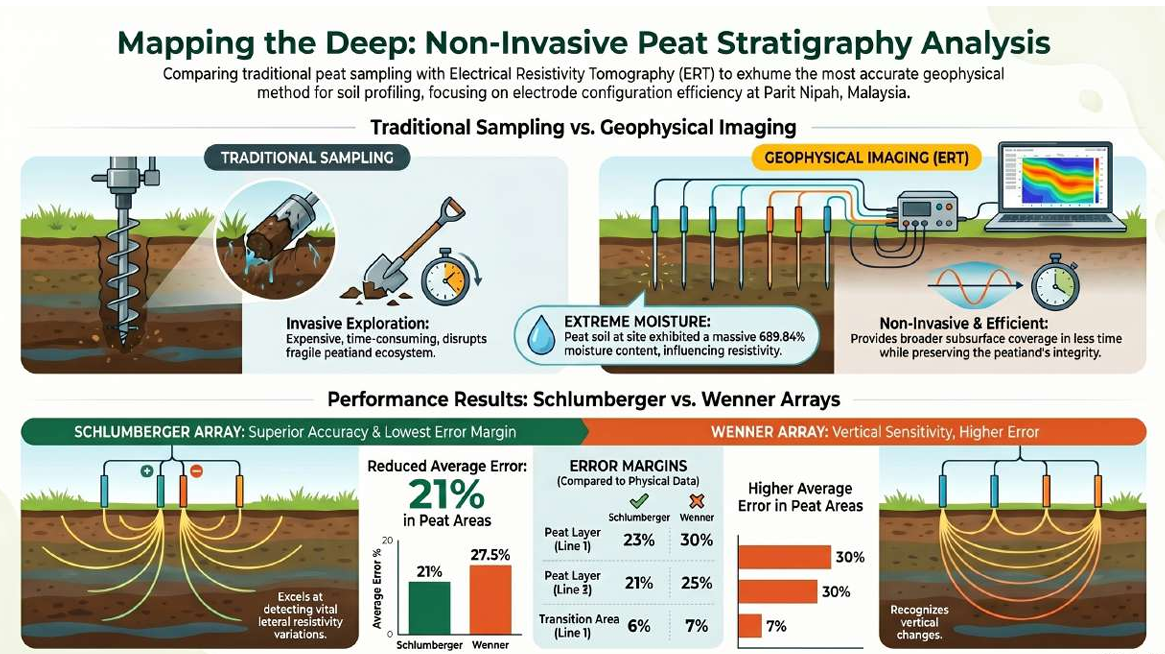
This research examined Electrical Resistivity Tomography (ERT) for analysing peat soil stratigraphy at Parit Nipah in Johor, Malaysia. Analyses were carried out with the Wenner and Schlumberger arrays along with two lines to assess their effectiveness for peat profiling. The electrode spacing was set at 2 metres for the longer configuration and 1 metre for the shorter one for Line 1, and 1 metre for the longer configuration and 0.5 metres for the shorter one for Line 2. This allowed for a thorough investigation of both lateral and vertical variations in resistivity. The maximum depth reached during the investigation was 16 metres on Line 1 and 7 metres on Line 2, using an ABEM Terrameter SAS 4000, steel electrodes, and Lund imaging cables. The ZondRes2d software was used for data processing and inversion, creating two-dimensional resistivity models. The Schlumberger array emerged as the preferred method for peat profiling, showing minimal differences compared to results from traditional peat sampling methods. While the Wenner protocol was also effective, it exhibited a slightly greater margin of error. This study highlights the ability of ERT to analyse peat stratigraphy efficiently and non-invasively, underscoring its advantages for peatland conservation and sustainable management practices.
References
A.A.M. Addly et al. IS THE RESIDUAL ASH METHOD APPLICABLE TO TROPICAL PEATLANDS? Mires and Peat, Volume 28 (2022), Article 08, 16 pp., http://www.mires- and-peat.net/, ISSN 1819-754X International Mire Conservation Group and International Peatland Society, DOI: 10.19189/MaP.2020.GDC.StA.2147
Adnan, A. (2008). Geotechnical Characteristics of Peat. ResearchGate.
Basri, K., Wahab, N., Talib, M. K. A., & Zainorabidin, A. (2019). Sub-surface profiling using electrical resistivity tomography (ERT) with complement from peat sampler. Civil Engineering and Architecture, 7(6).
Baines, D., et al., Electrical resistivity ground imaging (ERGI): a new tool for mapping the lithology and geometry of channel‐belts and valley‐fills. Sedimentology, 2002. 49(3): p. 441-449.
Binley, A., Hubbard, S. S., Huisman, J. A., & Revil, A. (2002). Geophysical characterization of subsurface properties. Springer.
Everett, M.E., Near-surface applied geophysics. 2013: Cambridge University Press.
Equipment, E.A., Peat Sampler Operating Instruction. Netherlands: Eijkelkamp Agrisearch Equipment, 2014.
Griffiths, D. and R. Barker, Two-dimensional resistivity imaging and modelling in areas of complex geology. Journal of applied Geophysics, 1993. 29(3-4): p. 211-226.
HabibM.Mohamad, B.Kasbi. (2021) Inventigating Peat Soil Stratigraphy and Marine Clay Formation Using the Geophysical Method in Padas Valley, Northen Borneo.
Herman, R., An introduction to electrical resistivity in geophysics. American Journal of Physics, 2001. 69(9): p. 943-952.
Hikmatullah and Sukarman (2014): Cultivated Peat Soils in Trial of ICCTF.
Huat, B. B., Kazemian, S., Prasad, A., & Barghchi, M. (2011). State of an art review of peat: General perspective. International Journal of the Physical Sciences, 6(8), 1988-1996.
Loke, M., Electrical imaging surveys for environmental and engineering studies. A practical guide to, 1999. 2.
Loke, M., Tutorial: 2-D and 3-D electrical imaging surveys. 2004.
Mesri, G., & Ajlouni, M. (2007). Engineering properties of fibrous peats. Journal of Geotechnical and Geoenvironmental Engineering, 133(7), 850-866.
Miele, M., et al. Rectangular Schlumberger resistivity arrays for delineating vadose zone clay- lined fractures in shallow tuff. in Symposium on the Application of Geophysics to Engineering and Environmental Problems 1996. 1996. Society of Exploration Geophysicists.
Mohd et al., Study of Various Soil Stabilization Techniques That Suitable for Parit Nipah Peat Soil. Recent Trends in Civil Engineering and Built Environment Vol. 3 No. 1 (2022) p. 1884-1892
Muhammad Yusa, Ari Sandyavitri, Sigit Sutikno. Application of electrical resistivity test to estimate carbon storage of tropical peat deposit (Case study of Bengkalis island) MATEC Web Conf. 276 05004 (2019) DOI: 10.1051/matecconf/201927605004
N. Wahab, M. K. A. T, K. Basri, and M. M. Rohani, “Segregation peat fiber and pre-consolidation pressure effect on the physical properties of reconstituted peat soil,” Interna tional Journal of Engineering and Advanced Technology (IJEAT), vol. 8, no. 6S3, pp. 640–647, 2019.
Norhaliza Wahab, Mohd Khaidir Abu Talib, Ahmad Khairul Abd Malik, Aziman Madun (2023) Effect Of Cement Stabilized Peat On Strength, Microstructure, And Chemical Analysis,Physics And Chemistry Of The Earth,ELSEVIER,129,1,ELSEVIER,1- 8,ISSN:14747065
Norhaliza Wahab, Mohd Khaidir Abu Talib, Nurlatifah Jumien, Aziman Madun, Faizal Pakir (2023) Comparative Study Of Peat Properties In Johore Malaysia,Asia-Pacific Journal Of Science And Technology,KHON KAEN UNIVERSITY, THAILAND,28,4,KHON KAEN UNIVERSITY, THAILAND,1-8,ISSN:25396293
Okpoli, C.C., Sensitivity and resolution capacity of electrode configurations. Geophysics, 2013.
Prabir K. Kolay and Siti Noor Linda Taib (2017). Physical and Geotechnical Properties of Tropical Peat and Its Stabilization. DOI: 10.5772/intechopen.
Razali, Siti & Hj. Bakar, Ismail & Zainorabidin, Adnan. (2013). Behaviour of Peat Soil in Instrumented Physical Model Studies. Procedia Engineering. 53. 145–155. 10.1016/j.proeng.2013.02.020.
Reynolds, J. M. (2011). An introduction to applied and environmental geophysics. John Wiley & Sons.
Slob, E., Optimal acquisition and synthetic electrode arrays, in SEG Technical Program Expanded Abstracts 2004. 2004, Society of Exploration Geophysicists. p. 1389-1392.
Wahab, A., Hasan, M., Mohd Kusin, F., Embong, Z., Zaman, Q. U., Babar, Z. U., & Imran, M.
S. (2022). Physical Properties of Undisturbed Tropical Peat Soil at Pekan District, Pahang, West Malaysia. International Journal of Integrated Engineering, 14(4), 403 414. https://penerbit.uthm.edu.my/ojs/index.php/ijie/article/view/8667
Zainorabidin, A., & Zolkefle, S. N. A. (2014). Dynamic behavior of Western Johore Peat, Malaysia. Published by Asia Pacific Chemical Biological and Environmental Engineering Society (APCBEES)
Downloads
Published
Issue
Section
License
Copyright (c) 2026 Malaysian Journal of Science (MJS)

This work is licensed under a Creative Commons Attribution-NonCommercial 4.0 International License.
Transfer of Copyrights
- In the event of publication of the manuscript entitled [INSERT MANUSCRIPT TITLE AND REF NO.] in the Malaysian Journal of Science, I hereby transfer copyrights of the manuscript title, abstract and contents to the Malaysian Journal of Science and the Faculty of Science, University of Malaya (as the publisher) for the full legal term of copyright and any renewals thereof throughout the world in any format, and any media for communication.
Conditions of Publication
- I hereby state that this manuscript to be published is an original work, unpublished in any form prior and I have obtained the necessary permission for the reproduction (or am the owner) of any images, illustrations, tables, charts, figures, maps, photographs and other visual materials of whom the copyrights is owned by a third party.
- This manuscript contains no statements that are contradictory to the relevant local and international laws or that infringes on the rights of others.
- I agree to indemnify the Malaysian Journal of Science and the Faculty of Science, University of Malaya (as the publisher) in the event of any claims that arise in regards to the above conditions and assume full liability on the published manuscript.
Reviewer’s Responsibilities
- Reviewers must treat the manuscripts received for reviewing process as confidential. It must not be shown or discussed with others without the authorization from the editor of MJS.
- Reviewers assigned must not have conflicts of interest with respect to the original work, the authors of the article or the research funding.
- Reviewers should judge or evaluate the manuscripts objective as possible. The feedback from the reviewers should be express clearly with supporting arguments.
- If the assigned reviewer considers themselves not able to complete the review of the manuscript, they must communicate with the editor, so that the manuscript could be sent to another suitable reviewer.
Copyright: Rights of the Author(s)
- Effective 2007, it will become the policy of the Malaysian Journal of Science (published by the Faculty of Science, University of Malaya) to obtain copyrights of all manuscripts published. This is to facilitate:
- Protection against copyright infringement of the manuscript through copyright breaches or piracy.
- Timely handling of reproduction requests from authorized third parties that are addressed directly to the Faculty of Science, University of Malaya.
- As the author, you may publish the fore-mentioned manuscript, whole or any part thereof, provided acknowledgement regarding copyright notice and reference to first publication in the Malaysian Journal of Science and Faculty of Science, University of Malaya (as the publishers) are given. You may produce copies of your manuscript, whole or any part thereof, for teaching purposes or to be provided, on individual basis, to fellow researchers.
- You may include the fore-mentioned manuscript, whole or any part thereof, electronically on a secure network at your affiliated institution, provided acknowledgement regarding copyright notice and reference to first publication in the Malaysian Journal of Science and Faculty of Science, University of Malaya (as the publishers) are given.
- You may include the fore-mentioned manuscript, whole or any part thereof, on the World Wide Web, provided acknowledgement regarding copyright notice and reference to first publication in the Malaysian Journal of Science and Faculty of Science, University of Malaya (as the publishers) are given.
- In the event that your manuscript, whole or any part thereof, has been requested to be reproduced, for any purpose or in any form approved by the Malaysian Journal of Science and Faculty of Science, University of Malaya (as the publishers), you will be informed. It is requested that any changes to your contact details (especially e-mail addresses) are made known.
Copyright: Role and responsibility of the Author(s)
- In the event of the manuscript to be published in the Malaysian Journal of Science contains materials copyrighted to others prior, it is the responsibility of current author(s) to obtain written permission from the copyright owner or owners.
- This written permission should be submitted with the proof-copy of the manuscript to be published in the Malaysian Journal of Science
Licensing Policy
Malaysian Journal of Science is an open-access journal that follows the Creative Commons Attribution-Non-commercial 4.0 International License (CC BY-NC 4.0)
CC BY – NC 4.0: Under this licence, the reusers to distribute, remix, alter, and build upon the content in any media or format for non-commercial purposes only, as long as proper acknowledgement is given to the authors of the original work. Please take the time to read the whole licence agreement (https://creativecommons.org/licenses/by-nc/4.0/legalcode ).