Investigation Public Holiday is Factor Affecting Dengue Cases by Using Arima and Arimax Model in Selangor and Sarawak from 2015 to 2019
DOI:
https://doi.org/10.22452/Keywords:
Box Jenkins, dengue, Malaysia, prediction models, ARIMAXAbstract
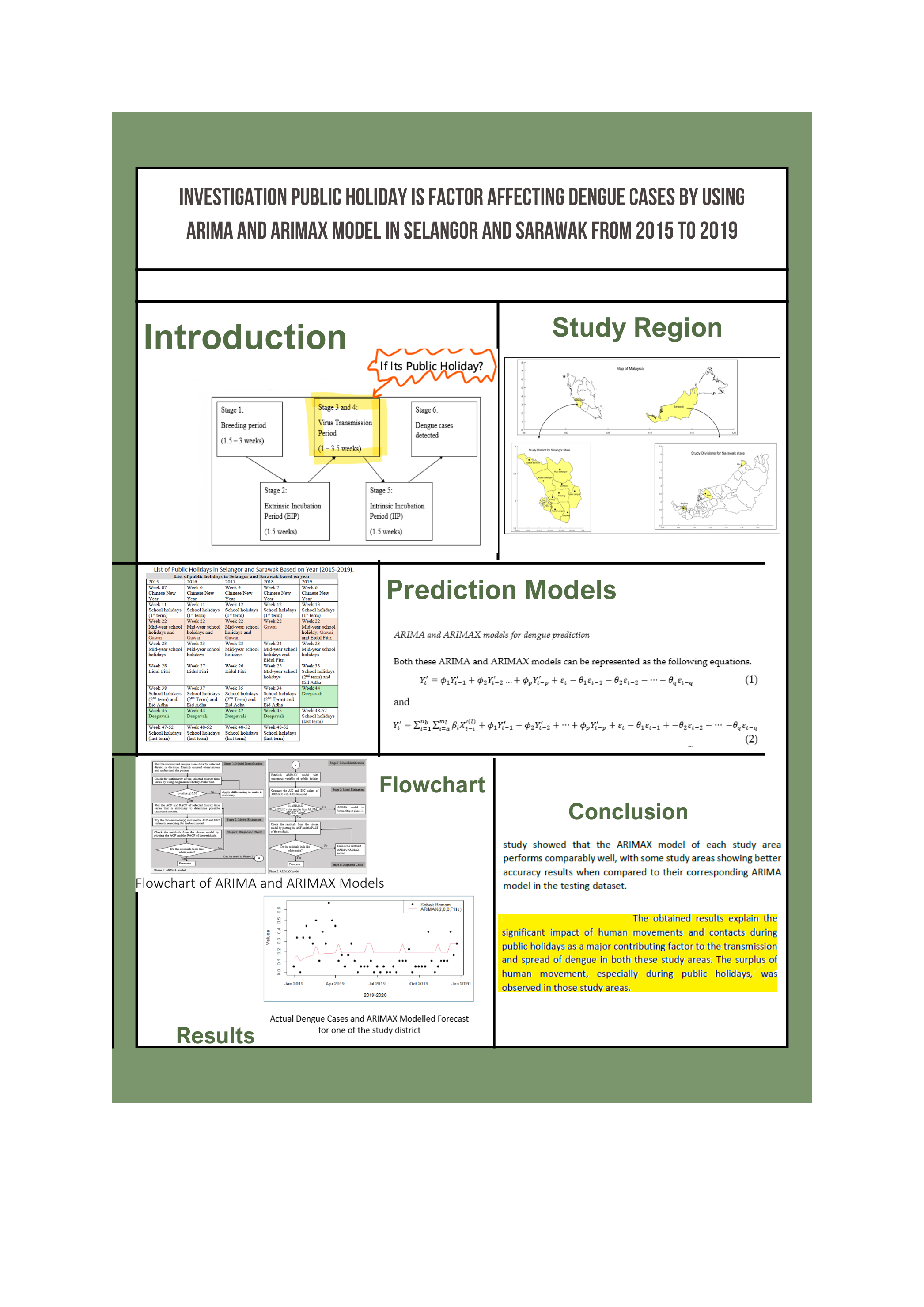
This study investigated the relationship between dengue cases and human movement, as represented by public holidays in Malaysia for two states, Selangor and Sarawak, using a weekly dataset from 2015 to 2019. This study developed dengue prediction models by employing Autoregressive Integrated Moving Average (ARIMA) and ARIMA with public holiday as the exogenous variable (ARIMAX) time series models. The Box Jenkins approach for model development with Akaike Information Criterion (AIC) and Bayesian Information Criterion (BIC) selection criteria are applied to select the optimum model by using the training dataset. This study, however, found the positive effect of human movement during public holidays is only apparent in three study areas; Klang and Sabak Bernam districts in Selangor state and Sibu division in Sarawak. The AIC and BIC values for Klang, Sabak Bernam, and Sibu were (-573.51, -556.89), (-162.93, -146.32), and (-446.64, -420.06), respectively. Despite this, the difference in the AIC and BIC values between ARIMA and ARIMAX models in other study areas is not large, and the study further found that the ARIMAX model of each study area did not fail to perform comparably well, with some study areas showing better accuracy scores when compared to their counterpart ARIMA model in the testing dataset. This concludes that public holidays, specifically the effect of human movement during that period, are significant factors for predicting dengue cases.
References
Aguiar, M., Rocha, F., Pessanha, J. E. M., Mateus, L., & Stollenwerk, N. (2014). Carnival or football, is there a real risk for acquiring dengue fever in Brazil during holidays seasons? Scientific Reports, 5. https://doi.org/10.1038/srep08462
Chan, M., & Johansson, M. A. (2012). The Incubation Periods of Dengue Viruses. PLoS ONE, 7(11). https://doi.org/10.1371/journal.pone.0050972
Cheong, Y. L., Burkart, K., Leitão, P. J., & Lakes, T. (2013). Assessing weather effects on dengue disease in Malaysia. International Journal of Environmental Research and Public Health, 10(12), 6319–6334. https://doi.org/10.3390/ijerph10126319
Harvie, S., Nor Aliza, A. R., Lela, S., & Razitasham, S. (2020). Detection of dengue virus serotype 2 (DENV-2) in population of Aedes mosquitoes from Sibu and Miri divisions of Sarawak using reverse transcription polymerase chain reaction (RT-PCR) and semi-nested PCR. In Tropical Biomedicine (Vol. 37, Issue 2).
Hossain, M. S. (2022). Megacity-centric mass mobility during Eid holidays: a unique concern for infectious disease transmission in Bangladesh. In Tropical Medicine and Health (Vol. 50, Issue 1). BioMed Central Ltd. https://doi.org/10.1186/s41182-022-00417-4
Hossain, M. S., Siddiqee, M. H., Siddiqi, U. R., Raheem, E., Akter, R., & Hu, W. (2020). Dengue in a crowded megacity: Lessons learnt from 2019 outbreak in Dhaka, Bangladesh. PLoS Neglected Tropical Diseases, 14(8), 1–5. https://doi.org/10.1371/journal.pntd.0008349
Islam, M. A., Hasan, M. N., Tiwari, A., Raju, M. A. W., Jannat, F., Sangkham, S., Shammas, M. I., Sharma, P., Bhattacharya, P., & Kumar, M. (2023). Correlation of Dengue and Meteorological Factors in Bangladesh: A Public Health Concern. International Journal of Environmental Research and Public Health, 20(6). https://doi.org/10.3390/ijerph20065152
Lin, H., Liu, T., Song, T., Lin, L., Xiao, J., Lin, J., He, J., Zhong, H., Hu, W., Deng, A., Peng, Z., Ma, W., & Zhang, Y. (2016). Community Involvement in Dengue Outbreak Control: An Integrated Rigorous Intervention Strategy. PLoS Neglected Tropical Diseases, 10(8). https://doi.org/10.1371/journal.pntd.0004919
Mahmud, N., Syuhada Muhammat Pazil, N., Jamaluddin, H., Aqilah Ali, N., Teknologi MARA, U., & Perlis Kampus Arau, C. (2021). Prediction of Dengue Outbreak: A Comparison Between ARIMA and Holt-Winters Methods ARTICLE HISTORY ABSTRACT. ESTEEM Academic Journal, 17, 101–111.
MOH, D. C. D. M. of H., MYSA, M. S. A., & MOSTI, M. of S. T. and I. (2023). Dengue Announcement by State in Malaysia for the year 2023. https://idengue.mysa.gov.my/ide_v3/index.php
Pliego Pliego, E., Velázquez-Castro, J., & Fraguela Collar, A. (2017). Seasonality on the life cycle of Aedes aegypti mosquito and its statistical relation with dengue outbreaks. Applied Mathematical Modelling, 50, 484–496. https://doi.org/10.1016/j.apm.2017.06.003
Rafi, A., Mousumi, A. N., Ahmed, R., Chowdhury, R. H., Wadood, A., & Hossain, G. (2020). Dengue epidemic in a non-endemic zone of Bangladesh: Clinical and laboratory profiles of patients. PLoS Neglected Tropical Diseases, 14(10), 1–14. https://doi.org/10.1371/journal.pntd.0008567
Rueda, L. M. (2008). Global diversity of mosquitoes (Insecta: Diptera: Culicidae) in freshwater. In Hydrobiologia (Vol. 595, Issue 1, pp. 477–487). https://doi.org/10.1007/s10750-007-9037-x
Sarawak Government. (n.d.). Retrieved February 15, 2024, from https://sarawak.gov.my/web/home/article_view/240/175/?id=158#175
Seah, A., Aik, J., Ng, L. C., & Tam, C. C. (2021). The effects of maximum ambient temperature and heatwaves on dengue infections in the tropical city-state of Singapore – A time series analysis. Science of the Total Environment, 775. https://doi.org/10.1016/j.scitotenv.2021.145117
Selangor.travel | Your Smart Online Travel Guide In Selangor. (n.d.). Retrieved January 24, 2024, from https://selangor.travel/
Shahid, F., Ony, S. H., Albi, T. R., Chellappan, S., Vashistha, A., & Alim Al Islam, A. B. M. (2020). Learning from Tweets: Opportunities and Challenges to Inform Policy Making during Dengue Epidemic. Proceedings of the ACM on Human-Computer Interaction, 4(CSCW1). https://doi.org/10.1145/3392875
Sippy, R., Herrera, D., Gaus, D., Gangnon, R. E., Patz, J. A., & Osorio, J. E. (2019). Seasonal patterns of dengue fever in rural Ecuador: 2009-2016. PLoS Neglected Tropical Diseases, 13(5). https://doi.org/10.1371/journal.pntd.0007360
Siriyasatien, P., Chadsuthi, S., Jampachaisri, K., & Kesorn, K. (2018). Dengue epidemics prediction: A survey of the state-of-the-art based on data science processes. In IEEE Access (Vol. 6, pp. 53757–53795). Institute of Electrical and Electronics Engineers Inc. https://doi.org/10.1109/ACCESS.2018.2871241
Thiruchelvam, L., Asirvadam, V. S., Dass, S. C., Daud, H., & Gill, B. S. (2017). K-Step Ahead Prediction Models for Dengue Occurrences.
Thiruchelvam, L., Dass, S. C., Asirvadam, V. S., Daud, H., & Gill, B. S. (2021). Determine neighboring region spatial effect on dengue cases using ensemble ARIMA models. Scientific Reports, 11(1). https://doi.org/10.1038/s41598-021-84176-y
Thiruchelvam, L., Dass, S. C., Zaki, R., Yahya, A., & Asirvadam, V. S. (2018). Correlation analysis of air pollutant index levels and dengue cases across five different zones in Selangor, Malaysia. Geospatial Health, 13(1), 102–109. https://doi.org/10.4081/gh.2018.613
Wu, X., Lang, L., Ma, W., Song, T., Kang, M., He, J., Zhang, Y., Lu, L., Lin, H., & Ling, L. (2018). Non-linear effects of mean temperature and relative humidity on dengue incidence in Guangzhou, China. Science of the Total Environment, 628–629, 766–771. https://doi.org/10.1016/j.scitotenv.2018.02.136
Yasmin, S., & Moniruzzaman, Md. (2024). Forecasting of area, production, and yield of jute in Bangladesh using Box-Jenkins ARIMA model. Journal of Agriculture and Food Research, 16, 101203. https://doi.org/10.1016/j.jafr.2024.101203
Downloads
Published
Issue
Section
License
Copyright (c) 2026 Malaysian Journal of Science (MJS)

This work is licensed under a Creative Commons Attribution-NonCommercial 4.0 International License.
Transfer of Copyrights
- In the event of publication of the manuscript entitled [INSERT MANUSCRIPT TITLE AND REF NO.] in the Malaysian Journal of Science, I hereby transfer copyrights of the manuscript title, abstract and contents to the Malaysian Journal of Science and the Faculty of Science, University of Malaya (as the publisher) for the full legal term of copyright and any renewals thereof throughout the world in any format, and any media for communication.
Conditions of Publication
- I hereby state that this manuscript to be published is an original work, unpublished in any form prior and I have obtained the necessary permission for the reproduction (or am the owner) of any images, illustrations, tables, charts, figures, maps, photographs and other visual materials of whom the copyrights is owned by a third party.
- This manuscript contains no statements that are contradictory to the relevant local and international laws or that infringes on the rights of others.
- I agree to indemnify the Malaysian Journal of Science and the Faculty of Science, University of Malaya (as the publisher) in the event of any claims that arise in regards to the above conditions and assume full liability on the published manuscript.
Reviewer’s Responsibilities
- Reviewers must treat the manuscripts received for reviewing process as confidential. It must not be shown or discussed with others without the authorization from the editor of MJS.
- Reviewers assigned must not have conflicts of interest with respect to the original work, the authors of the article or the research funding.
- Reviewers should judge or evaluate the manuscripts objective as possible. The feedback from the reviewers should be express clearly with supporting arguments.
- If the assigned reviewer considers themselves not able to complete the review of the manuscript, they must communicate with the editor, so that the manuscript could be sent to another suitable reviewer.
Copyright: Rights of the Author(s)
- Effective 2007, it will become the policy of the Malaysian Journal of Science (published by the Faculty of Science, University of Malaya) to obtain copyrights of all manuscripts published. This is to facilitate:
- Protection against copyright infringement of the manuscript through copyright breaches or piracy.
- Timely handling of reproduction requests from authorized third parties that are addressed directly to the Faculty of Science, University of Malaya.
- As the author, you may publish the fore-mentioned manuscript, whole or any part thereof, provided acknowledgement regarding copyright notice and reference to first publication in the Malaysian Journal of Science and Faculty of Science, University of Malaya (as the publishers) are given. You may produce copies of your manuscript, whole or any part thereof, for teaching purposes or to be provided, on individual basis, to fellow researchers.
- You may include the fore-mentioned manuscript, whole or any part thereof, electronically on a secure network at your affiliated institution, provided acknowledgement regarding copyright notice and reference to first publication in the Malaysian Journal of Science and Faculty of Science, University of Malaya (as the publishers) are given.
- You may include the fore-mentioned manuscript, whole or any part thereof, on the World Wide Web, provided acknowledgement regarding copyright notice and reference to first publication in the Malaysian Journal of Science and Faculty of Science, University of Malaya (as the publishers) are given.
- In the event that your manuscript, whole or any part thereof, has been requested to be reproduced, for any purpose or in any form approved by the Malaysian Journal of Science and Faculty of Science, University of Malaya (as the publishers), you will be informed. It is requested that any changes to your contact details (especially e-mail addresses) are made known.
Copyright: Role and responsibility of the Author(s)
- In the event of the manuscript to be published in the Malaysian Journal of Science contains materials copyrighted to others prior, it is the responsibility of current author(s) to obtain written permission from the copyright owner or owners.
- This written permission should be submitted with the proof-copy of the manuscript to be published in the Malaysian Journal of Science
Licensing Policy
Malaysian Journal of Science is an open-access journal that follows the Creative Commons Attribution-Non-commercial 4.0 International License (CC BY-NC 4.0)
CC BY – NC 4.0: Under this licence, the reusers to distribute, remix, alter, and build upon the content in any media or format for non-commercial purposes only, as long as proper acknowledgement is given to the authors of the original work. Please take the time to read the whole licence agreement (https://creativecommons.org/licenses/by-nc/4.0/legalcode ).